
AI Courses in Ireland: Master’s Guide for Indian Students

Ireland Study Guide · 2026–2030 Skills Outlook AI, Cloud Computing and Data Engineering in Ireland: Which Master’s Should You Choose? A practical guide for Indian students comparing technology master’s pathways in Ireland—what each specialisation involves, which academic backgrounds may fit, and how to assess a course beyond its title. For Indian students exploring postgraduate study abroad · Updated October 2026 Choosing a technology master’s degree can feel difficult when universities use overlapping terms such as artificial intelligence, data science, cloud computing and software engineering. For Indian students exploring AI courses in Ireland, the best choice is not automatically the programme with the trendiest name. Instead, look for a course that matches your previous studies, the skills you want to build and the kind of work you want to explore. Ireland is worth researching for students interested in technology-related postgraduate study. A skills report published by Ireland’s Expert Group on Future Skills Needs (EGFSN) in September 2026 projects growth in the country’s digital specialist workforce through 2030 and identifies areas including cybersecurity, AI, machine learning, cloud, data and software engineering. These are workforce projections—not a promise that every graduate will find a job. Start with the evidence, not the hypeUse Ireland’s digital-skills outlook as a reason to investigate relevant programmes. Then verify the actual curriculum, admission requirements, fees, work-placement options and current career information for each university. AI vs cloud computing vs data engineering: what is the difference? Pathway 01 Artificial Intelligence and Machine Learning Focuses on building systems that learn from data, recognise patterns, make predictions or support intelligent applications. Explore if you enjoy: programming, mathematics, statistics, experimentation and model evaluation. Pathway 02 Cloud Computing Focuses on deploying and operating applications and infrastructure using cloud platforms, automation, networking and security practices. Explore if you enjoy: systems, troubleshooting, infrastructure, scripting and reliable application delivery. Pathway 03 Data Engineering Focuses on designing pipelines and platforms that collect, transform, validate and deliver data for analytics and AI systems. Explore if you enjoy: SQL, programming, databases, data quality and building dependable workflows. Which specialisation fits your academic background? Your undergraduate degree does not determine your future by itself, but it can affect admission eligibility and how prepared you are for the technical content. Use this table as an initial guide, then confirm the entry criteria for each programme. Your background Pathways to investigate What to check before applying Computer Science / IT AI/ML, cloud computing, data engineering, software engineering Required programming languages, algorithms, mathematics and database knowledge Electronics / ECE / Electrical AI/ML, applied data, embedded or software-related pathways, depending on prerequisites Whether the programme accepts non-CS graduates and requires bridging modules Mathematics / Statistics AI/ML, data science, analytics and selected data engineering programmes Programming expectations, computing prerequisites and practical project content Other engineering disciplines Applied analytics, selected computing conversion programmes, or domain-specific AI Whether the course is designed for conversion students or requires a computing degree Business or non-technical degree Analytics or conversion programmes where eligibility permits Whether technical prerequisites are mandatory; do not assume direct entry to advanced AI programmes How to compare master’s programmes in Ireland 1. Read module descriptions, not just course names When comparing AI courses in Ireland, look for a balance of machine learning foundations, programming, model evaluation and substantial projects. For cloud computing, pay attention to infrastructure, networking, automation, distributed systems and security modules. Meanwhile, data engineering programmes should cover databases, data pipelines, data modelling, processing systems and data quality. Since module names vary by university, compare the actual learning outcomes rather than relying only on course titles. 2. Check the practical learning component Additionally, review whether the programme includes a capstone, applied project, laboratory work, industry project or placement. Confirm whether a placement is guaranteed, competitive or simply an option. Practical work can help you demonstrate your skills; however, it does not guarantee employment. 3. Check entry requirements carefully Before applying, compare your transcript with the university’s stated requirements. Look for minimum academic grades, relevant undergraduate subjects, programming or mathematics prerequisites, English-language test requirements and application deadlines. If your degree is not explicitly listed, ask the admissions team for clarification. 4. Calculate the full cost However, do not compare tuition fees alone. Build a budget covering tuition, accommodation, food, transport, health insurance, visa-related expenses, deposits and an emergency reserve. Since fees and living costs vary by institution, city and year, use current official university and government information before making a decision. 5. Research career outcomes realistically In addition, read the university’s graduate-outcomes information and investigate the skills employers request in relevant job descriptions. Your outcomes depend on technical ability, projects, communication, experience, work authorisation and the market at the time you graduate. Therefore, treat a national skills forecast as useful context, not an individual job guarantee. Skills to build before starting your master’s You do not need to master every tool before applying. Start with the foundations that support your chosen direction: Programming: build confidence in Python or another language relevant to your target programme. SQL and data basics: useful for data engineering, analytics and many AI projects. Mathematics and statistics: especially important for machine learning and data-focused study. Systems fundamentals: networking, operating systems and scripting can help with cloud-related study. Portfolio projects: document a few projects clearly, including your approach, tools, results and limitations. Communication: practise explaining technical decisions and presenting project work. A simple decision framework If your main interest is… Start by exploring… Ask yourself Building predictive or intelligent applications AI / Machine Learning Am I prepared for programming, statistics and model evaluation? Deploying and maintaining modern infrastructure Cloud Computing / Cloud Engineering Do I enjoy systems, networking, automation and troubleshooting? Making data usable for analytics and AI Data Engineering / Data Platforms Do I enjoy databases, pipelines, data modelling and reliability? Keeping options open across software and data Broader computing or software programmes with relevant electives Does the curriculum offer flexibility without losing technical depth? Application checklist for Indian students Shortlist courses based on curriculum and eligibility—not ranking alone. Check each
Master’s in AI Abroad for Indian Students: Degree or Domain + AI
Study abroad · Postgraduate guide Master’s in AI Abroad for Indian Students: AI Degree or Domain + AI? The smartest choice may not be the degree with “AI” in its title. Start with the work you want to do, then compare the curriculum that can help you get there. A practical guide from Uniplus Overseas Educational Consultancy Choose a postgraduate course by fit, skills and curriculum—not by a trend alone. The short answer A dedicated AI master’s is worth exploring if you want to build, evaluate or research AI systems and have a strong foundation in mathematics, statistics and programming. A domain-plus-AI pathway may fit better if you want to apply data and AI methods in a field such as finance, biotechnology, healthcare or engineering. Compare both routes against your academic background, career direction, course modules and total budget. In this guide Start with the role, not the degree title AI degree vs domain + AI Pathways to explore What recent research says Examples of AI programmes How to assess a course Compare destinations carefully Your shortlisting checklist Mistakes to avoid Frequently asked questions Final takeaway Start with the role you want—not the degree title When searching for a master’s in AI abroad for Indian students, it is easy to begin with university rankings or popular course names. A more useful first step is to describe the kind of problems you want to solve after graduation. Do you want to develop machine-learning models, work on AI infrastructure, or investigate how AI systems behave? A dedicated AI or machine-learning programme may deserve a place on your shortlist. Would you rather use data to improve financial decisions, medical research, manufacturing or supply chains? Then a programme that combines your subject knowledge with computing and analytics may be just as relevant. Neither route guarantees a job. Course titles vary between universities, and two programmes with similar names can teach very different things. Read the module list, entry requirements and assessment methods before deciding. If you are still exploring destinations, begin with our guide to UK universities for Indian students and use it alongside course-level research. AI degree vs domain + AI: what changes? A dedicated AI degree focuses on the methods and systems behind artificial intelligence. Depending on the programme, this may include machine learning, statistics, programming, model evaluation and responsible AI. A domain-plus-AI pathway combines technical methods with a specific area of application. Examples include financial technology, bioinformatics, health informatics or intelligent manufacturing. The balance between domain study and technical depth differs by course. Use this comparison as a starting point—not as a ranking of degrees. What to compare Dedicated AI master’s Domain + AI pathway Main emphasis AI methods, models and technical systems Applying data and AI to problems in a defined field Useful preparation Mathematics, statistics and programming experience Relevant subject knowledge plus a willingness to build technical skills Questions to ask How much machine learning, coding and model evaluation is taught? Are both the domain and the technical components substantial? Possible direction AI engineering, machine learning or further research, depending on skills and experience Analytics or specialist work within a field, depending on the programme and employer Potential mismatch The course assumes more quantitative or programming knowledge than you have The course uses AI in its marketing but offers limited technical depth These are general distinctions, not universal rules. Confirm the prerequisites, curriculum and career support on each university’s official website. Domain-plus-AI pathways worth investigating Think of the combinations below as research directions. They are not promises of employment, and the best option depends on your undergraduate subject and interests. PATHWAY 01 Engineering + robotics or intelligent manufacturing Explore programmes involving automation, control systems, sensors, computer vision or manufacturing data. Check whether the course includes practical engineering work as well as AI concepts. PATHWAY 02 Finance + analytics or fintech Look for a blend of statistics, data analysis, risk, financial systems and programming. Decide whether you prefer quantitative finance, business analytics or technology-focused study. PATHWAY 03 Biotechnology + bioinformatics Investigate how biological data, computational methods and statistics are taught together. Check the expected life-science and coding background before applying. PATHWAY 04 Healthcare + health informatics Compare modules in health data, information systems, analytics and privacy. Review how the course handles the special responsibilities involved in working with health information. PATHWAY 05 Supply chain + operations analytics Look for forecasting, optimisation, decision science and operations modules alongside data tools. This may appeal if you enjoy solving planning and logistics problems. PATHWAY 06 Cybersecurity + AI security Check for foundations in networks, secure systems, threat analysis and the security risks of AI-enabled applications. A course title alone cannot establish its technical depth. Engineering students interested in climate and energy systems may also want to explore renewable energy study options abroad. Investigate the actual modules rather than assuming every programme includes AI. What recent research says about AI and work Research can help explain why a thoughtful course choice matters, but it cannot tell every student which degree to take. These three sources examine different questions and populations, so their findings should not be treated as interchangeable. 1. Skills are changing—not just technical job titles A joint report published through the International Labour Organization in August 2026 describes AI adoption as reshaping workplace skill needs. It highlights cognitive, socio-emotional, digital and data skills, and identifies AI literacy as an increasingly foundational capability. The report discusses workplaces broadly; it does not establish that a dedicated AI master’s is best for every student. 2. Automation risk and productivity potential are different measures The World Bank’s 2026 World Development Report says that 4.5% of jobs in low- and middle-income countries are at risk of automation by generative AI, compared with 14.2% in high-income countries. It also estimates that 16.2% of jobs in developing economies could experience meaningful productivity gains, compared with 18.7% in high-income countries. 4.5% vs 14.2%Jobs at risk of automation in low- and middle-income versus high-income countries 16.2% vs 18.7%Jobs with potential
Cost of Studying in New Zealand for Indian Students 2027

Cost of Studying in New Zealand for Indian Students 2027 | Uniplus Overseas Study Abroad Guide Cost of Studying in New Zealand for Indian Students 2027 Tuition Fees | Living Costs | Visa Funds | Scholarships | Complete Guide Your complete, expert-backed guide to studying in New Zealand. Plan smarter, explore global opportunities, and take a step closer to a brighter future. World-Class Education Safe & Peaceful Environment Work While You Study Global Career Opportunities A Brighter Tomorrow Awaits STUDY • EXPLORE • GROW • BELONG WORLD-CLASS UNIVERSITIES BREATHTAKING DESTINATIONS BRIGHTER CAREER PATHS A WELCOMING COMMUNITY Quick Answer: Total Cost to Study in New Zealand Tuition Fees NZD 30,000 – 55,000+ per year Living Expenses NZD 18,000 – 25,000+ per year First-Year Total NZD 51,700 – 80,000+ (≈ ₹26 – 42 lakh+) Visa Living Funds NZD 20,000 / year (or NZD 1,667/month) Get Personalised Guidance Explore Study in New Zealand Home › Blog › Cost of Studying in New Zealand for Indian Students 2027 Updated: September 2026 Planning to study in New Zealand means looking beyond tuition fees alone. Indian students should budget for tuition, accommodation, food, transport, visa costs, medical insurance, and initial settlement expenses. If you are still comparing universities, intakes, and admission requirements, review our complete guide to studying in New Zealand before finalising your finances. Tuition Fees in New Zealand for Indian Students Tuition fees vary by university, course and level of study. Here’s a planning range for international students. Study Level / Field Typical Annual Tuition (NZD) Approx. in INR (₹)* Bachelor’s – Arts, Commerce, Business 30,000 – 42,000 15 – 21.8 lakh Bachelor’s / Master’s – STEM, IT, Engineering 36,000 – 55,000+ 18 – 28.6 lakh+ Postgraduate Diploma / Master’s – Coursework 32,000 – 52,000 16 – 27 lakh Note: These are planning ranges, not fixed university fees. Always check the latest fee schedule of your chosen university. Indicative conversion: ₹50–₹52 per NZD. Cost of Living in New Zealand Use these as planning ranges; actual costs vary by city, housing and lifestyle. Expense Budget (NZD) Higher-Cost (NZD) Accommodation 750 – 950 1,300 – 2,000+ Food & groceries 360 – 450 450 – 650 Utilities & internet 70 – 100 120+ Transport 100 – 140 80 – 140 Personal & mobile 150 – 225 200 – 300 Estimated Monthly Total 1,430 – 1,865 2,130 – 3,210+ Official Cost Benchmarks Shared accommodation From NZD 140/week Basic groceries NZD 80–120/week Public transport Up to NZD 37/week Phone plan About NZD 19/month Published student cost benchmarks from Study with New Zealand. Spending varies by region. First-Year Cost Breakdown A realistic first-year budget includes tuition, living costs, visa and initial settlement. NZD 30,000 – 50,000+ Tuition Fees (Year 1) + NZD 18,000 – 24,000 Living Expenses (12 months) + NZD 2,200 – 3,500 Visa, Medical & Travel (Initial Outlay) + NZD 1,500 – 2,500 Bond & Setup (Refundable / Gear) = NZD 51,700 – 80,000+ ≈ ₹26 – 42 lakh+ (First-Year Total) Cost of Living in Major New Zealand Student Cities City choice can change your accommodation and day-to-day budget. City Budget Planning Student Consideration Auckland Plan carefully for accommodation Larger city with extensive public transit and housing types Wellington Compare rent by neighbourhood Central housing can be competitive; evaluate suburban options Christchurch Compare current rental listings Flatter terrain, manageable student commuting costs Hamilton Compare rent and transport together Compact university-city environment with good flatting options Dunedin Check student flat availability High-density student population centered around campus Important: There is no single “cheapest city” for every student. Accommodations, commute distances, and lifestyle changes alter the total figure. 04 New Zealand Student Visa Financial Requirements Official evidence required by Immigration New Zealand (INZ). 1 Tuition Evidence Proof of payment of tuition fees for the first academic year or proof of eligible approved scholarship/funding. 2 NZD 20,000 / Year Official annual living funds requirement for courses 1+ year in duration, or NZD 1,667 per month for shorter terms. 3 Travel & Medical Outward flight ticket or proof of funds to purchase one, plus compliant comprehensive international student medical insurance. Visa Threshold vs. Realistic Living: Immigration New Zealand currently requires evidence of NZD 20,000 per year for living costs for tertiary study of one year or more, or NZD 1,667 per month for shorter study periods. This is an immigration financial threshold, not necessarily your total real-world living budget. Need help calculating your tuition, living funds, and visa financial documentation? Speak directly with our New Zealand education consultants in Hyderabad. Talk to our team → 05 Frequently Asked Questions Direct answers to common cost and planning questions. How much does it cost to study in New Zealand for Indian students? A practical first-year planning range in this guide is approximately NZD 51,700–80,000+, depending on tuition, living costs, visa-related expenses and initial setup. At an indicative rate of ₹50–₹52 per NZD, that is roughly ₹26–₹42 lakh+. What is the average tuition fee in New Zealand? International tuition varies by university and subject. Planning ranges are NZD 30,000–42,000 for arts and business degrees, NZD 32,000–52,000 for postgraduate coursework, and NZD 36,000–55,000+ for STEM, engineering, and IT courses. How much does it cost to live in New Zealand as a student? Living costs depend primarily on accommodation type and city. Official benchmarks from Study with New Zealand cite shared flats starting from NZD 140/week, groceries at NZD 80–120/week, and public transport around NZD 37/week, yielding a realistic budget of NZD 1,430–1,865 per month for shared living. How much money should I budget for my first year? A comprehensive first-year budget must account for four distinct pillars: Year 1 tuition (NZD 30K–50K+), 12 months of living expenses (NZD 18K–24K), visa, health insurance & flight tickets (NZD 2.2K–3.5K), and initial setup/tenancy bond deposits (NZD 1.5K–2.5K). What financial proof is required for a New Zealand student visa? Immigration New Zealand requires evidence of NZD 20,000 per year for living costs for tertiary study of one year or more, or NZD 1,667 per month for shorter study periods.
APS Certificate Documents Checklist: Indian Student Guide
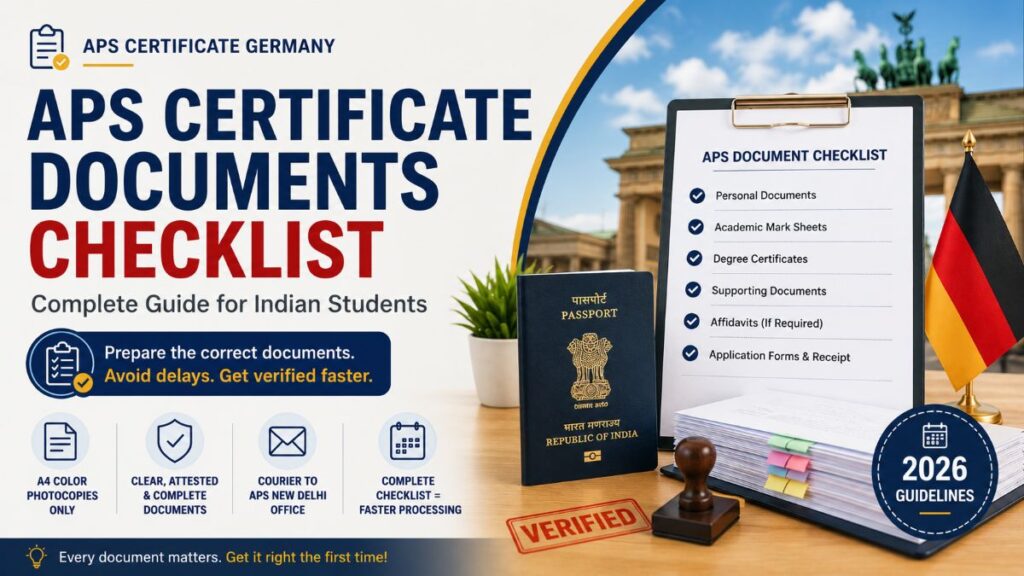
APS Certificate Documents | Print Checklist Uniplus Overseas — Germany Cluster Spoke Supporting Spoke · Copy Requirements APS Certificate Documents Checklist: A Complete Print Blueprint Structuring your verification package correctly prevents application rejections. Review the complete list of mandatory academic and identity papers required for submission below. Print Medium A4 Color Copies Do not send original degrees Verification Base Clean Photocopies Must show front and back layout By Uniplus Overseas Editorial Board | Fact-Checked Submission Metrics 📄 4 Core Files 🕒 5 Minute Check 📦 Post Required 📅 Updated: July 2026 Germany Study Guide → APS Certificate Guide → Documents Checklist Need Help Compiling Paperwork? If you are unsure how to sort semester cards, arrange credit certificates, or establish correct name affidavit layouts, you can visit our physical Germany Education Consultancy in Hyderabad office for step-by-step assistance. 📘 Looking for the complete process, strict eligibility rules, updated fees, and comprehensive FAQs? Read our comprehensive APS Certificate for Germany Guide. Compiling the correct APS Certificate documents bundle is a vital milestone for Indian applicants moving to German universities. The Academic Evaluation Centre evaluates profiles entirely through physical record verification. Therefore, sending an incomplete package will result in immediate application blocks. Crucially, you should never mail original certificates or diplomas via courier post. The office reviews high-quality, full-size color copies on standard A4 sheets. Consequently, tracking the precise layout rules prevents expensive administrative delays. Mandatory Identity and Application Papers First, every applicant must provide a core layer of identification papers and procedural transaction records. For example, ensure that you place these standardized sheets at the absolute top of your physical mailing folder: 📄 Signed Portal Registration Form The official application form downloaded straight from the portal after profile creation. You must attach a recent passport-sized photograph meeting clean ICAO specifications. 💳 Consular Verification Receipt A printed color copy of your standard transaction confirmation slip. This provides physical proof that the mandatory ₹18,000 baseline processing fee has been successfully cleared. 🛂 Identification Records Clear color duplicates of your passport’s first and last information pages. Additionally, include a clear copy of your DigiLocker-linked Aadhaar card to accelerate profile validation. ✍ Student Authorization Letter A mandatory signed authorization template allowing the German Embassy to contact your home university registrar directly to verify transcripts. 🚨 CRITICAL ALERT: COURIER PHOTOCOPY RULE Never send original degree certificates, transcripts, or school certificates in your mail package. The embassy works exclusively with color photocopies on standard A4 paper. Original submissions will not be returned and risk getting permanently lost in transit. Academic Records Breakdown by Level Beyond identity files, the transcript stack varies depending on whether you are tracking undergraduate pathways or graduate entries. Review the formal layout structure closely: Academic Path Type Required Components Critical Layout Rules Undergraduate Class 10 & 12 Mark sheets + Passing Certificates. Ensure cumulative Class 12 score hits the 70% threshold. Graduate Master’s Bachelor Degree + Semester-wise breakdown mark sheets. Consolidated cards require separate semester breakdowns attached. Special Streams Language Proficiency Cards (IELTS/TestDaF) if applicable. dMAT Aptitude certificate required for core tech fields. Next, remember that if your original university documents are written in an Indian regional language, you must provide a notarized English translation copy. However, documents issued natively in English or bilingual formats do not require notarization. Common Mistakes to Avoid Most file updates freeze because of tiny naming variations. For example, if your university transcripts show small spelling changes compared to the name printed on your passport, the application will stall. Therefore, including a legal notarized affidavit resolving the spelling is highly recommended. Finally, ensure you copy both sides of your certificates if the back contains university grading keys. Once your package is fully sorted, dispatch it via a secure courier directly to the official gate desk in New Delhi. Frequently Asked Questions Do I need to get my English documents notarized? + No, certificates already issued in English or bilingual formats do not require notarization. Notarization is only mandatory for official translations of documents originally issued in regional languages. Can I apply using a provisional degree certificate? + Yes, if your final university degree diploma has not been printed yet, a copy of a valid provisional degree certificate bearing the registrar’s official seal is completely accepted. Is a single consolidated transcript enough for Master’s tracks? + No, a consolidated transcript is not accepted on its own. You must include individual, semester-wise mark sheets covering every single year of your Bachelor’s timeline. Official Reference Channels To track system criteria variations, fee adjustments, or portal setups directly at the source, consult official channels directly: Official APS India Portal ↗ g.a.s.t. e.V. Exam Portal ↗ Anabin Central Database Standards ↗ Cluster Authority Hub This supporting article links directly to our master core guides: 🔗 Master APS Hub Page Ecosystem Navigation Related structural modules within this cluster: ➔ Spoke 1: Processing Time ⏳ Spoke 3: Fees Breakdown ⏳ Spoke 4: Common Mistakes Content Integrity Reviewed regularly and updated immediately when official German consular guidance changes. © 2026 Uniplus Overseas. Developed alongside informational structures from APS New Delhi and g.a.s.t. e.V. frameworks. uniplusoverseas.com
APS Certificate Processing Time: Indian Students
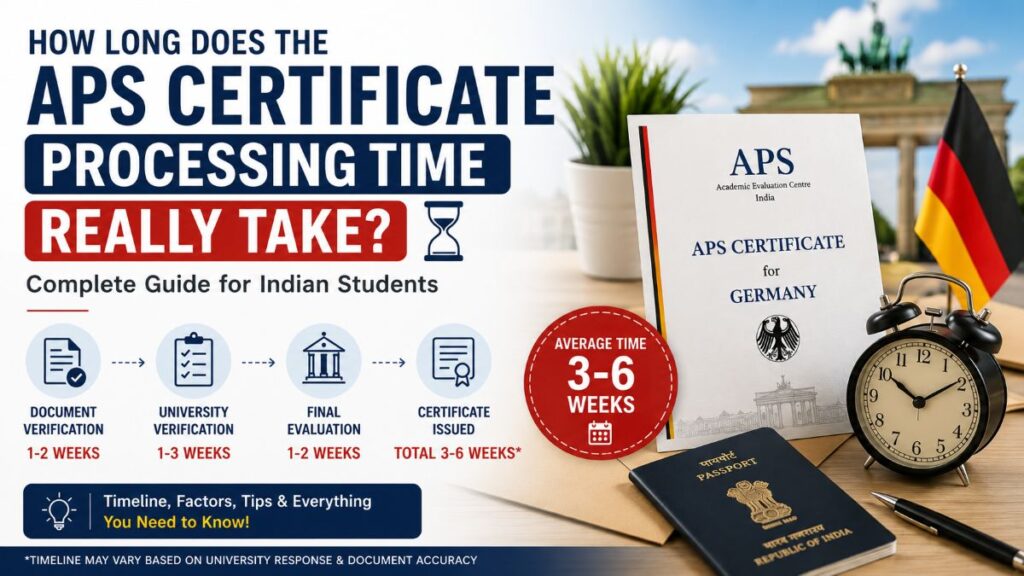
APS Certificate Processing Time: Indian Student Guide Uniplus Overseas — Germany Spoke Update Supporting Spoke · Timeline Guide APS Certificate Processing Time: How Long Does It Really Take? Planning your intake windows correctly requires knowing the exact timeline of your document clearance. Review the standard evaluation phases and typical delay variables below. Standard Window 3 – 6 Weeks From couriered package arrival Verification Mode Digital DigZert Sent directly via consular mail By Uniplus Editorial Board | Fact-Checked Operational Timeline 📅 Updated: July 2026 Need Urgent Verification Help? If you are facing tracking roadblocks or need direct help structuring your documentation package to avoid timeline extensions, you can visit our local Germany Education Consultancy in Hyderabad for face-to-face assistance. 📘 Looking for the complete process, strict eligibility rules, updated fees, and comprehensive FAQs? Read our comprehensive APS Certificate for Germany Guide. Calculating the exact **APS Certificate processing time** is a critical factor for Indian students mapping out university application windows. Under normal operating conditions, the Academic Evaluation Centre in New Delhi completes verification within **3 to 6 weeks**. However, structural changes in stream mandates can introduce variance into this baseline window. For example, applications submitted during peak seasonal intake frames—specifically around the closing dates for the Winter and Summer semesters—naturally experience higher queues. Consequently, initiating your application early is the safest method to protect your admission plan. The Internal Verification Phases Explained To understand why the pipeline takes multiple weeks, we must break down the workflow after your physical documentation parcel arrives at the New Delhi consular gate. The evaluation board reviews your files through a highly structured sequence: 1 Data Logging and Fee Match (Days 1–5) The administration opens your couriered package to confirm that the physical contents match the online form. Next, they match your profile against the ₹18,000 transaction log. 2 Institutional Inquiry (Days 5–20) The evaluation board contacts your home university registrar or secondary school board directly via secure electronic channels. They request formal confirmation that your transcripts are real. 3 DigZert Generation (Days 20–30) Once your university validates your marks, the embassy prints and locks your digital verification certificate, sending it straight to your email account. Common Triggers That Extend Your Processing Time While the standard roadmap finishes in under a month, minor filing mistakes can stall your portfolio for weeks. For instance, the most common roadblock stems from slow institutional responses. If your Indian university takes a long time to answer the embassy’s confirmation mail, your file stays paused indefinitely. Filing Scenario Estimated Window Primary Impact Factor Perfect Portfolio 3 – 4 Weeks Rapid university digital verification reply. Peak Admission Season 5 – 8 Weeks High consular file volumes from May to July. Institutional Delays 6 – 12 Weeks University registrar requires physical follow-ups. Typo/Name Mismatch File Frozen Requires a legal affidavit to resume processing. Therefore, letting your college examination desk know about your application in advance is highly recommended. By alerting them to look out for the embassy’s inquiry, you can significantly accelerate the response cycle. Furthermore, ensuring that you submit individual semester mark sheets instead of just a single consolidated transcript prevents immediate sorting blocks. Strategic Intake Timing for 2026 and 2027 To guarantee that your document lands before university portals close, you must structure your timeline backwards. For the Winter Semester intake, you should ideally submit your physical package no later than March. For the Summer Semester intake, aiming for a September submission provides a safe cushion. Finally, keep in mind that modifying your issued digital certificate file in any way will invalidate it. Do not combine the PDF or change its file name, as doing so breaks the digital signature. For a complete look at how this timeline aligns with your broad application journey, visit our central Study in Germany Guide. Cluster Hub Link This supporting article links directly to our central authority guides: 🔗 Master APS Hub Page Content Audit Monitored weekly against circulars issued by the Academic Evaluation Centre New Delhi. © 2026 Uniplus Overseas. Built alongside verified operational timelines from the German Embassy New Delhi networks. uniplusoverseas.com
Cost of Studying in Australia for Indian Students
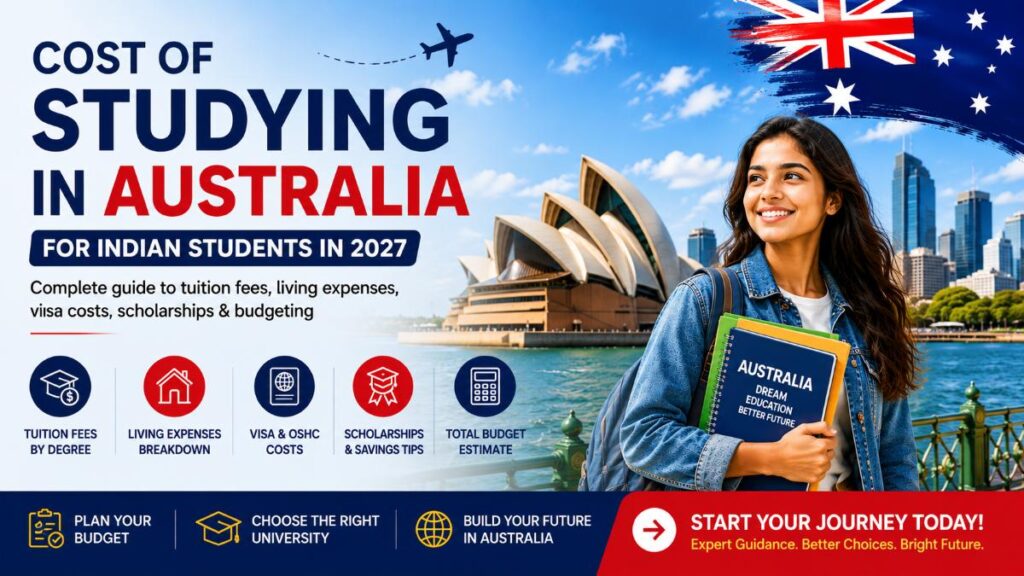
Cost of Studying in Australia for Indian Students (2027 Guide) | Uniplus Overseas Uniplus Overseas — Australia Study Guide Updated for 2027 intakes Cost of Studying in Australiafor Indian Students A 2027 budgeting dossier — tuition, rent, visa fees, and OSHC, broken down city by city so you know the real number before you apply. Total annual range A$45,000 – A$90,000+ Visa fee (2026) A$2,000 Reading time ~9 minutes The Real Number What does the cost of studying in Australia actually add up to? For most Indian students, the total cost of studying in Australia falls between A$45,000 and A$90,000 per year, once tuition, rent, food, transport, insurance, and visa charges are all counted together. However, that range hides a lot of variation. A student at a Group of Eight university in Sydney and a student at a non-Go8 university in Adelaide can end up paying nearly double the difference, simply because of where they chose to study. Before this guide, you may have already read our overview on studying in Australia for Indian students in 2027 or compared institutions in our breakdown of the top universities in Australia for Indian students. This guide picks up from there and answers the question both of those leave open: what will it actually cost you, line by line? Average annual tuition feeBachelor’s or Master’s, most universities A$22,000 – A$50,000 Average annual living costRent, food, transport, utilities A$18,000 – A$30,000 One-time visa and insurance costsSubclass 500 fee + OSHC for one year A$2,500 – A$2,700 Typical first-year totalTuition + living + visa + OSHC, combined A$45k – A$83k These figures are indicative 2026–27 estimates compiled from Australian Department of Home Affairs guidance and published university fee schedules. Because fees are reviewed annually and vary by course, you should always confirm the exact number for your program on the university’s official fees page before budgeting. Cost Driver #1 Tuition fees by degree and field Tuition is the single biggest line item in the cost of studying in Australia, and it varies enormously depending on your degree level and field. For example, a humanities bachelor’s degree can cost less than half of what an MBA or a medical degree costs in the same city. Bachelor’s degree (per year)A$20,000 – A$52,000 Master’s coursework (per year)A$22,000 – A$50,000 MBA (full program)A$60,000 – A$95,000 Medicine / Dentistry (per year)A$65,000 – A$85,000 Foundation / pathway programsA$36,000 – A$39,000 VET diploma (per year)A$12,000 – A$28,000 A few patterns are worth planning around, because they affect your total cost more than any single fee figure: Go8 universities sit at the higher end of every band, since prestige and research funding both feed into the sticker price. Non-Go8 universities such as Macquarie and UTS typically charge 15–30% less for comparable programs, without a meaningful drop in teaching quality. Because fees are indexed annually, you should budget for a modest year-on-year increase across a multi-year degree, not just the first-year figure. Therefore, the listed price for Year 1 is rarely the final price for Year 3 — always ask the university for its indexation policy in writing. Course-Level Fee CheckWant the exact fee for your specific course, not just the average band? We’ll pull it from the official source before you apply. Get My Fee Breakdown → Cost Driver #2 Living costs by city: where you study changes everything Although tuition gets most of the attention, your choice of city is often what actually decides whether the cost of studying in Australia feels manageable or overwhelming. Sydney and Melbourne carry a real premium; Adelaide, Perth, and Brisbane do not. Sydney Most expensive A$2,200 – $4,000+ Monthly living cost, all categories combined Shared room: A$300–450/week Highest rent and transport costs nationally Largest graduate job market in finance and tech Melbourne Second most expensive A$1,900 – $3,800 Roughly 10% cheaper than Sydney overall Shared room: A$250–400/week Strong consulting and business hub Large international student community Brisbane Balanced option A$1,800 – $3,200 Subtropical city, moderate rent growth Shared room: A$180–250/week Lower cost of living than Sydney or Melbourne Growing tech and biotech job market Adelaide Most affordable major city A$1,400 – $2,800 16% cheaper than Sydney, 13% cheaper than Melbourne Shared room: A$180–250/week Tiered Go8 fee discounts available at Adelaide University Known as Australia’s food capital Perth Affordable, resource-sector jobs A$1,800 – $3,300 Lower living costs, strong mining-sector salaries Shared room: A$180–250/week Qualifies as regional for some visa and PR purposes Home to UWA, the state’s top-ranked university Hobart Cheapest overall ~A$2,500/month Consistently ranks as Australia’s lowest-cost student city Significant savings on rent versus mainland cities Smaller course range, mostly at the University of Tasmania Best fit for highly budget-conscious applicants City living-cost ranges are drawn from the Study Australia government cost-of-living calculator and current city-level student budgeting data, and are indicative only. Your actual spend will depend on your accommodation type, lifestyle, and shared versus private housing choices. Mandatory Costs Visa, insurance, and other costs you cannot skip Beyond tuition and rent, a handful of costs are mandatory for every international student in Australia, regardless of university or city. Because these are fixed obligations rather than lifestyle choices, you should treat them as non-negotiable lines in your budget. Item Cost When it’s paid Student visa (Subclass 500) A$2,000 Before arrival, non-refundable Overseas Student Health Cover (OSHC) A$500 – $700/yr Before visa lodgement, for full course duration Minimum living cost evidence (DHA) A$29,710/yr Shown as proof of funds, not a direct payment Enrolment / acceptance deposit A$200 – $5,000 After accepting your offer Student services & amenities fee A$300 – $1,000/yr Billed by the university annually Health examination (if required) A$300 – $500 Before visa approval Visa and insurance figures reflect Department of Home Affairs charges current as of 2026, including the Subclass 500 fee increase to A$2,000 effective 1 July 2025. Since these figures are reviewed periodically, you should confirm the current charge at immi.homeaffairs.gov.au before lodging your application. Day-to-Day Spend What a typical month actually costs Once you are settled, your monthly budget
Study in Australia for Indian Students in 2027: Complete Guide

Study in Australia for Indian Students in 2027: Complete Guide Planning to study in Australia for Indian students has become one of the most effective ways to build a highly competitive global career. Because Australian institutions seamlessly combine premium academic programs with exceptional lifestyle advantages, thousands of international applicants target this destination every year. Consequently, navigating your choices carefully across university rankings, intake deadlines, and visa regulations is essential for success. This master guide delivers a complete overview to help you successfully map out your future parameters for the upcoming 2027 entry cycle. Quick Answer: Why Study in Australia? Choosing to study in Australia for Indian students offers unmatched long-term benefits. Key structural highlights include: Top-Ranked Universities: Access to the famous Group of Eight (Go8) research institutions. Practical Course Styles: Programs designed in direct coordination with global corporate partners. Lucrative Grants: Institutional fee waivers covering 10% to 50% of annual tuition fees. Post-Study Work Rights: Clear pathways to gain local industry training after graduation via subclass 485. Key Academic Benefits Down Under First and foremost, qualifications earned here are protected through the Australian Qualifications Framework (AQF). This strict national system ensures your degree carries immense prestige when evaluated by multinational companies worldwide. Furthermore, local universities are globally celebrated for pioneering research breakthroughs, such as Wi-Fi networks and ultrasound tech. Therefore, students are directly integrated into an ecosystem that values hands-on practical learning over theoretical textbook formats. Top Universities in Australia for Indian Students To organize your strategy for the 2027 academic intakes, you must analyze how the leading institutions align with your budget. This verified layout displays premium Group of Eight (Go8) hubs alongside top-tier technology networks: University Name Group Allocation Indicative Annual Fees (AUD) Popular Course Strengths Key Available Funding University of Melbourne Group of Eight (Go8) AUD 42,000 – 48,000 Computer Science, MBA, Data Science Melbourne International Undergraduate University of Sydney Group of Eight (Go8) AUD 41,000 – 47,000 Engineering, Business Analytics, Law Vice-Chancellor’s International Australian National University Group of Eight (Go8) AUD 40,000 – 46,000 Cyber Security, Physics, Public Policy ANU Chancellor’s International UNSW Sydney Group of Eight (Go8) AUD 41,000 – 46,000 Artificial Intelligence, Engineering UNSW Future International University of Queensland Group of Eight (Go8) AUD 39,000 – 45,000 Biotechnology, Environmental Science UQ Excellence Scholarships Monash University Group of Eight (Go8) AUD 38,000 – 44,000 Pharmacy, Data Science, Nursing Monash International Merit University of Western Australia Group of Eight (Go8) AUD 37,000 – 43,000 Marine Science, Mining Engineering Global Excellence Scholarship University of Adelaide Group of Eight (Go8) AUD 36,000 – 42,000 Wine Marketing, Computer Science Global Citizens Scholarship UTS (University of Technology Sydney) Non-Go8 (Tech Network) AUD 34,000 – 39,000 Cyber Security, Business Analytics UTS Vice-Chancellor’s Merit RMIT University Non-Go8 (Tech Network) AUD 33,000 – 38,000 Art & Design, Master of Data Science RMIT International Student Award High-Demand Disciplines for 2027 Selecting the right course stream is critical to maximize your global career opportunities. Currently, the most sought-after programs include: Computer Science & Cyber Security: Programs focusing heavily on cloud network defenses, secure software architecture, and corporate infrastructure management. Artificial Intelligence & Data Science: High-velocity training tracks that cover machine learning, predictive data models, and advanced database analytics. MBA & Business Analytics: Elite management streams designed to bridge corporate boardroom strategies with modern data architectures. Nursing & Healthcare Management: Heavily regulated programs providing extensive hands-on hospital placements and clinical experience. Analyzing the Cost of Studying in Australia Tuition and Living Fees Your absolute financial investment depends primarily on your institution’s tier and your choice of city. Specifically, regional locations like Adelaide or Hobart generally offer much lower accommodation outlays compared to downtown Sydney or Melbourne. To ensure total financial readiness, students must evaluate tuition scales alongside healthcare premiums and daily transit options. Learn more about these specific requirements via our upcoming detailed dashboard: Cost of Studying in Australia. Unlocking Australia Scholarships for Indian Students Are you looking to minimize your tuition outlays? Fortunately, competitive applicants can target a variety of funding pools, including Destination Australia regional grants and automatic university merit awards. To review specific score thresholds, entry parameters, and timeline schedules, read our future comprehensive breakdown: Australia Scholarships for Indian Students. Navigating the Student Visa Architecture The Subclass 500 Framework Securing your student visa requires satisfying a strict, document-backed assessment. Under current guidelines, applicants must pass the Genuine Student (GS) evaluation, which examines your academic background, home ties, and career progression logic. Additionally, immigration rules dictate that you must display liquid proof of financial capacity. Specifically, you need access to at least **AUD 29,710 per year** to cover mandatory living allowances. To plan your documentation checklist without errors, check out our upcoming roadmap: Australia Student Visa Guide. Understanding the Australian Academic Intakes February versus July Timelines Unlike destinations centered around a single entry window, the Australian system offers two major intake opportunities every year: Semester 1 (February Intake): This is the primary entry window across all campuses. It provides access to all course variants and maximum scholarship pools. Semester 2 (July Intake): This is a highly popular option for Indian graduates finishing exams in June. It allows you to transition directly into your studies without a gap year. To map out your application submission dates accurately, bookmark our detailed scheduling guide: Australia Intakes Timeline. Why Indian Students Choose Australia ✔ Work-Term Flexibility: International students can legally work up to 48 hours per fortnight while semesters are in session. ✔ Unlimited Break Hours: You can work full-time hours during official university vacation periods. ✔ Graduate Visa Access: Stay on to acquire crucial international corporate experience after finishing your studies. Frequently Asked Questions (FAQs) Q1: Is Australia safe for Indian students? Yes, Australia is widely recognized as one of the safest study-abroad environments. Major cities provide student safety hubs, active transit safety programs, and multicultural neighborhoods to ensure a smooth transition. Q2: What are the minimum English requirements for an Australian student visa? To secure a standard Subclass 500 Student Visa, applicants generally need a
Cost of Studying in the UK for Indian Students in 2027: Complete Guide
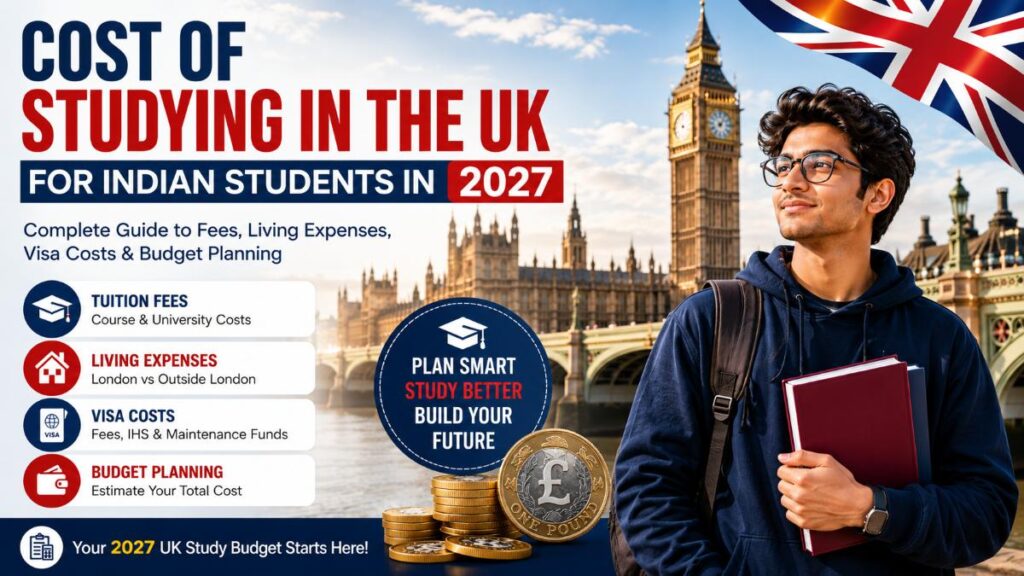
Cost of Studying in the UK for Indian Students in 2027 – Complete Budget Guide 2027 Intake Guide Cost of Studying in the UK for Indian Students in 2027 Comprehensive breakdown of Tuition Fees, Living Expenses, Visa Costs & Budgets Updated 2027 Fees Official Sources Verified Complete Budget Guide Get Free UK Counselling → Explore Universities 🎓 Total Cost Range ₹29L – ₹80L Per Year (Approx. Total) ⏱️ Program Duration 1 Year Most Master’s Programs 🌟 Top Advantage 1 Year Shorter vs. US/Canada (2 Years) 💼 Post-Study Work 18 Months From Jan 2027 (New Rule) Three Major Cost Components Planning your journey effectively requires understanding how your expenses are divided. 📖 Tuition Fees The core tuition amount paid directly to your chosen UK university based on your level, course specifications, and chosen field of study. 🏠 Living Expenses All-inclusive daily costs covering student accommodation, food, essential transport, bills, lifestyle items, and personal contingencies. 🎫 Visa & Immigration Costs Mandatory expenses for government entry approvals, student visa registration fees, healthcare surcharges, and flight arrangements. Tuition Fees in the UK (Annual) Degree Level Tuition Fees (GBP) Approx. in INR* Undergraduate(BSc/BEng/BA) £11,400 – £38,000 ₹14.6L – ₹48.6L Master’s(MSc/MA) £9,000 – £32,000 ₹11.5L – ₹40.9L MBA Programs £18,000 – £45,000+ ₹19.8L – ₹49.5L+ * Calculated at an illustrative baseline exchange rate of 1 GBP = ₹110 INR. 💡 💡 Time & Money Saver: A standard 1-year Master’s degree in the UK saves you an entire full year of both tuition fees and living expenses compared to traditional 2-year formats globally. Living Expenses: Monthly Breakdown 📍 In London Accommodation£600 – £900+ Food£200 – £350 Transport£100 – £200 Miscellaneous£150 – £300 Total Monthly£1,300 – £1,400+ 🌳 Outside London Accommodation£300 – £600 Food£150 – £300 Transport£50 – £100 Miscellaneous£100 – £250 Total Monthly£900 – £1,300 ✅ Studying at regional destinations outside London cuts your immediate daily living costs by up to 30%! UK Student Visa Costs (2027) Student Visa Fee £558 Healthcare Surcharge (IHS) £776 / year University Deposit £2.5k – £5k Flight Ticket (Approx.) ₹35k – ₹80k Ensure visa registry details match the official confirmation statement issued by your educational institution before fee submission. ⚠️ UKVI Maintenance Funds (Proof of Funds) Location Type Required Monthly Fund Total Checklist Requirement (9 Mos) Studying in London £1,529 / mo £13,761 (~₹15.1 Lakh) Studying Outside London £1,171 / mo £10,539 (~₹11.6 Lakh) 🕒 The 28-Day Rule: Your personal bank account must strictly maintain this entire financial minimum balance for 28 consecutive days non-stop prior to clicking visa application submit. Total Cost Estimate by Student Profile Budget Master’s (Outside London) ₹25 – ₹35 Lakh Average Master’s (Outside London) ₹35 – ₹50 Lakh Master’s in London ₹45 – ₹65 Lakh Premium MBA Programs ₹60 Lakh+ Most Affordable UK Cities Coventry Low living costs paired with exceptional institutional frameworks. Sheffield Renowned for highly welcoming student atmospheres & reasonable rents. Leeds Impressive academic rankings with balanced, lower daily pricing indexes. Nottingham Excellent lifestyle options available at highly modest spending thresholds. Glasgow Premium Scottish legacy education structure with structural affordability. Strategies to Reduce Academic Costs Smart choices to help you optimize and manage your financial plans effectively. 🏅 Apply for Scholarships Earmark major vehicles like Chevening, Commonwealth fellowships, GREAT grants, or university-exclusive stipends to drastically slash active tuition overheads. 🗺️ Choose the Right City By shifting focus onto high-ranking educational bodies located across regional clusters outside Greater London, structural living costs instantly compress. 💼 Part-Time Employment Utilize legal student allowance parameters to secure part-time roles up to 20 hours weekly throughout dynamic term periods and full-time hours across seasonal vacations. 📊 Compare Total Program Cost Always weigh total multi-year commitments. A higher 1-year tuition bill frequently undercuts comparative 2-year outlays when living bills are consolidated. UK vs. US vs. Canada: The Ultimate Comparison The UK’s biggest single structural advantage is TIME. ✓ 1-Year Master’s structure translates directly to minimized overall cost exposure. ✓ Accelerates entry into global employment pipelines 12 months ahead of peers. ✓ Achieves a considerably faster baseline timeline for return on investment (ROI). 🇬🇧 🇺🇸 🇨🇦 Frequently Asked Questions Your most pressing budget, visa, and financial clearance inquiries resolved. How much does it cost to study in the UK for Indian students in 2027? On average, a complete year encompasses roughly ₹29L to ₹80L. This comprehensively aggregates classroom fees along with regional living balances depending on course specific brackets. Is London more expensive than other UK cities? Yes, distinctly. Standard internal metrics prove living allocations within London demand an extra 30% financial margin compared with regional zones due to accelerated urban rent factors. How much bank balance is required for a UK student visa? You must officially show liquid resources covering first-year academic fees plus statutory 9-month maintenance funds. This equals exactly £13,761 inside London or £10,539 at universities outside London. Can students work while studying in the UK? Yes. Valid student visa regulations permit active international visa holders to take up employment for a strict limit of 20 hours each week during terms and unlimited full hours throughout holiday periods. Can scholarships reduce study costs? Absolutely. Government allocations and institutional waivers provide a path to receive full funding or significant tuition write-offs based on candidate eligibility. Is studying in the UK worth the investment? Given the 1-year compressed degree timeframe coupled with the competitive 18-month post-study visa path starting in 2027, the return on investment timeline is shortened considerably. Plan Your UK Study Budget with Expert Guidance Don’t navigate complex financial rules alone. Get custom, step-by-step cost analysis maps shaped entirely around your desired course, selected city, and individual scholarship profile. ✓ University & Course Shortlisting ✓ Cost Estimation & Budget Planning ✓ Scholarship Application Guidance ✓ Visa Documentation & Proof of Funds Support Apply Now – It’s Free! → Sources & Disclaimer: Fees and baseline financial figures are curated using current reference markers from UK Visas and Immigration (UKVI) guidelines alongside registered university cost structures for the 2026/2027 calendar year. Final calculations remain strictly subject to localized exchange
Best Courses to Study in France
Best Courses to Study in France France is renowned for its rich history, culture, and vibrant lifestyle. It is also a popular study abroad destination, attracting thousands of international students every year. With its top-notch universities, diverse range of courses, and affordable education, France offers an excellent opportunity for students to pursue their academic and career aspirations. In this article, we will explore some of the best courses to study in France, ranging from management and engineering to pure science and linguistics. 1. Management / MBA With its ever-booming economy, France is an ideal destination for business and management students. The capital city, Paris, offers a perfect blend of opportunities in universities and career prospects. Management is one of the most popular courses in France, with specializations available in entrepreneurship, project management, strategic management, and general management. uniplus overseas. Notably, nine out of fifty colleges in France are included among the best colleges in Europe. Additionally, some of the best business schools in France, such as are also ranked among the top B-schools globally. INSEAD HEC Paris ESSEC Business School Grenoble Graduate School of Business EDHEC Business School 2. Engineering France is globally recognized for its competitive engineering universities. These institutions prioritize both academic excellence and practical training, ensuring that students receive a well-rounded education. The emphasis on practical training is reflected in the high research output of top universities in France. Engineering students have the opportunity to work with renowned French companies like Airbus, Alcatel, and Alstom. Some of the best engineering universities in France include: Ecole Centrale de Lyon Ecole Polytechnique Institut National des Sciences Appliquées de Lyon (INSA) Ecole Centrale de Paris Grenoble INP, Grenoble Institute of Technology 3. Pure Science France is home to excellent science and research universities, particularly in the fields of chemistry and physics. The country has a strong tradition of scientific excellence, with many Nobel Prize winners belonging to France. French universities offer a perfect mix of historical traditions and modern scientific advancements. Students pursuing pure science can expect high-quality education and research opportunities. Some of the top universities in France for pure science include: University of Paris-Sud University of Grenoble Alpes Université de Strasbourg Ecole Polytechnique Ecole Normale Supérieure, Paris Université Pierre et Marie Curie (UPMC) 4. Linguistics France is well-known for its excellent linguistic programs, making it an ideal destination for students interested in language studies. Linguistics encompasses the study of language origins, history, usage, and formation. This field is beneficial for those pursuing careers in journalism, translation, language research, and more. Linguistics courses typically cover topics such as syntax, grammar, pronunciation, and phonetics. Some of the best language schools in France include: ISIT France University of Kent – Paris Campus University of Reims Lille Catholic University 5. Philosophy France has a rich philosophical tradition and is home to many renowned thinkers. The country’s blend of history, modernization, diversity, and traditional roots makes it an excellent place to study philosophy. Paris, in particular, is known for its top universities offering philosophy programs. Some of the best philosophy universities in France include: Pantheon-Sorbonne University Ecole Normale Supérieure Sorbonne University Other Popular Courses Apart from the aforementioned courses, France also offers excellent programs in culinary arts, fashion designing, and hotel management. These courses provide students with unique opportunities to explore their creative talents and gain practical skills in their chosen fields. For more information on studying in France and the application process for undergraduate and postgraduate courses, stay tuned with the Uniplus Overseas team! Conclusion France offers a plethora of opportunities for international students, with its top universities, affordable education, and diverse range of courses. Whether you’re interested in pursuing a career in management, engineering, pure science, linguistics, or philosophy, France has something to offer. By studying in France, you can not only gain a world-class education but also immerse yourself in the country’s rich culture and vibrant lifestyle. So, if you’re considering studying abroad, France should definitely be on your list of potential destinations. Related Blogs Top 3 Study abroad education consultancy in Madhapur, hyderabad Study in France for Indian Students After 12th Top 5 Best Overseas Education Consultants in Hyderabad Top New Zealand Scholarships for Indian Students Studying Abroad on a Budget: Money-Saving Tips for International Students
Studying Abroad on a Budget: Money-Saving Tips for International Students
Studying Abroad on a Budget: Money-Saving Tips for International Students Subtitle: How to Make the Most of Your Study Abroad Experience without Breaking the Bank Introduction Studying abroad on a budget can be an incredible opportunity to expand your horizons, immerse yourself in a new culture, and gain valuable international experience. However, the costs associated with studying abroad can be intimidating, especially for international students on a tight budget. In this blog post, we will provide you with practical tips and strategies to help you make the most of your study abroad experience without breaking the bank. Money-Saving Tips for International Students 1. Research Affordable Study Abroad Destinations Choosing an affordable study abroad destination is the first step towards saving money. Consider countries where the cost of living is relatively lower, such as Eastern European countries or some Asian countries. These destinations often offer quality education at a fraction of the cost compared to more expensive countries like the United States or the United Kingdom. 2. Look for Scholarships and Grants There are numerous scholarships and grants available for international students. Conduct thorough research to find scholarships that are specifically designed for students studying abroad. Many universities and organizations offer financial aid to help students cover tuition fees, living expenses, or travel costs. Start your search early and apply for as many scholarships as possible to increase your chances of receiving funding. 3. Create a Realistic Budget Before you embark on your study abroad journey, it’s crucial to create a detailed budget that covers all your expenses. Consider factors such as tuition fees, accommodation, transportation, food, insurance, and leisure activities. Be realistic about your spending habits and prioritize your expenses accordingly. This will help you keep track of your finances and avoid unnecessary expenses. uniplus overseas 4. Save Money on Accommodation Accommodation can be one of the biggest expenses while studying abroad. Consider cost-effective options such as university dormitories or shared apartments. These options are often more affordable compared to renting a private apartment. Additionally, you can explore house-sitting or house-sharing opportunities, which can significantly reduce your accommodation costs. 5. Utilize Public Transportation Public transportation is usually cheaper than owning a car or using taxis. Take advantage of student discounts on public transportation passes or consider purchasing a monthly pass, which can help you save money in the long run. Additionally, walking or cycling can be a cost-effective and healthy alternative for short distances. 6. Cook Your Own Meals Eating out can quickly add up and drain your budget. Instead, opt for cooking your own meals as much as possible. Look for local markets and grocery stores where you can buy fresh and affordable ingredients. Cooking not only saves money but also allows you to explore local cuisines and experiment with new recipes. 7. Take Advantage of Student Discounts As a student, you are entitled to various discounts on transportation, accommodation, entertainment, and food. Always carry your student ID card and inquire about student discounts wherever you go. Many museums, theaters, and tourist attractions offer reduced admission fees for students, so make sure to take advantage of these opportunities. 8. Find Part-Time Jobs or Internships Working part-time or taking up internships can not only provide you with valuable work experience but also help you earn some extra money. Check if your study visa allows you to work part-time and explore job opportunities in your study abroad destination. Many universities have job boards or career centers that can assist you in finding suitable employment. 9. Travel Smart Traveling can be an exciting part of studying abroad, but it can also be expensive. To save money on travel expenses, plan your trips in advance and look for budget-friendly options such as discounted flights or group travel packages. Consider traveling during off-peak seasons when prices are generally lower. Additionally, explore local travel options like trains or buses, which can be more cost-effective than flying. 10. Embrace a Frugal Lifestyle Living frugally doesn’t mean depriving yourself of experiences. It’s about making conscious choices and prioritizing what matters most to you. Look for free or low-cost activities, such as attending local festivals, exploring parks, or joining student clubs and organizations. Take advantage of the resources available to you as a student, such as libraries, sports facilities, and cultural events. Conclusion Studying abroad on a budget is not only possible but also a rewarding experience. By following these money-saving tips and strategies, you can make the most of your study abroad journey without compromising the quality of your education or your overall experience. Remember to plan ahead, research your options, and stay disciplined with your finances. Studying abroad should be an enriching and transformative experience, and with careful financial planning, it can be within reach for students from all backgrounds. Related Blogs Top 3 Study abroad education consultancy in Madhapur, hyderabad Study in France for Indian Students After 12th Top 5 Best Overseas Education Consultants in Hyderabad Best Courses to Study in France Top New Zealand Scholarships for Indian Students