
APS Certificate Documents Checklist: Indian Student Guide

APS Certificate Documents | Print Checklist Uniplus Overseas — Germany Cluster Spoke Supporting Spoke · Copy Requirements APS Certificate Documents Checklist: A Complete Print Blueprint Structuring your verification package correctly prevents application rejections. Review the complete list of mandatory academic and identity papers required for submission below. Print Medium A4 Color Copies Do not send original degrees Verification Base Clean Photocopies Must show front and back layout By Uniplus Overseas Editorial Board | Fact-Checked Submission Metrics 📄 4 Core Files 🕒 5 Minute Check 📦 Post Required 📅 Updated: July 2026 Germany Study Guide → APS Certificate Guide → Documents Checklist Need Help Compiling Paperwork? If you are unsure how to sort semester cards, arrange credit certificates, or establish correct name affidavit layouts, you can visit our physical Germany Education Consultancy in Hyderabad office for step-by-step assistance. 📘 Looking for the complete process, strict eligibility rules, updated fees, and comprehensive FAQs? Read our comprehensive APS Certificate for Germany Guide. Compiling the correct APS Certificate documents bundle is a vital milestone for Indian applicants moving to German universities. The Academic Evaluation Centre evaluates profiles entirely through physical record verification. Therefore, sending an incomplete package will result in immediate application blocks. Crucially, you should never mail original certificates or diplomas via courier post. The office reviews high-quality, full-size color copies on standard A4 sheets. Consequently, tracking the precise layout rules prevents expensive administrative delays. Mandatory Identity and Application Papers First, every applicant must provide a core layer of identification papers and procedural transaction records. For example, ensure that you place these standardized sheets at the absolute top of your physical mailing folder: 📄 Signed Portal Registration Form The official application form downloaded straight from the portal after profile creation. You must attach a recent passport-sized photograph meeting clean ICAO specifications. 💳 Consular Verification Receipt A printed color copy of your standard transaction confirmation slip. This provides physical proof that the mandatory ₹18,000 baseline processing fee has been successfully cleared. 🛂 Identification Records Clear color duplicates of your passport’s first and last information pages. Additionally, include a clear copy of your DigiLocker-linked Aadhaar card to accelerate profile validation. ✍ Student Authorization Letter A mandatory signed authorization template allowing the German Embassy to contact your home university registrar directly to verify transcripts. 🚨 CRITICAL ALERT: COURIER PHOTOCOPY RULE Never send original degree certificates, transcripts, or school certificates in your mail package. The embassy works exclusively with color photocopies on standard A4 paper. Original submissions will not be returned and risk getting permanently lost in transit. Academic Records Breakdown by Level Beyond identity files, the transcript stack varies depending on whether you are tracking undergraduate pathways or graduate entries. Review the formal layout structure closely: Academic Path Type Required Components Critical Layout Rules Undergraduate Class 10 & 12 Mark sheets + Passing Certificates. Ensure cumulative Class 12 score hits the 70% threshold. Graduate Master’s Bachelor Degree + Semester-wise breakdown mark sheets. Consolidated cards require separate semester breakdowns attached. Special Streams Language Proficiency Cards (IELTS/TestDaF) if applicable. dMAT Aptitude certificate required for core tech fields. Next, remember that if your original university documents are written in an Indian regional language, you must provide a notarized English translation copy. However, documents issued natively in English or bilingual formats do not require notarization. Common Mistakes to Avoid Most file updates freeze because of tiny naming variations. For example, if your university transcripts show small spelling changes compared to the name printed on your passport, the application will stall. Therefore, including a legal notarized affidavit resolving the spelling is highly recommended. Finally, ensure you copy both sides of your certificates if the back contains university grading keys. Once your package is fully sorted, dispatch it via a secure courier directly to the official gate desk in New Delhi. Frequently Asked Questions Do I need to get my English documents notarized? + No, certificates already issued in English or bilingual formats do not require notarization. Notarization is only mandatory for official translations of documents originally issued in regional languages. Can I apply using a provisional degree certificate? + Yes, if your final university degree diploma has not been printed yet, a copy of a valid provisional degree certificate bearing the registrar’s official seal is completely accepted. Is a single consolidated transcript enough for Master’s tracks? + No, a consolidated transcript is not accepted on its own. You must include individual, semester-wise mark sheets covering every single year of your Bachelor’s timeline. Official Reference Channels To track system criteria variations, fee adjustments, or portal setups directly at the source, consult official channels directly: Official APS India Portal ↗ g.a.s.t. e.V. Exam Portal ↗ Anabin Central Database Standards ↗ Cluster Authority Hub This supporting article links directly to our master core guides: 🔗 Master APS Hub Page Ecosystem Navigation Related structural modules within this cluster: ➔ Spoke 1: Processing Time ⏳ Spoke 3: Fees Breakdown ⏳ Spoke 4: Common Mistakes Content Integrity Reviewed regularly and updated immediately when official German consular guidance changes. © 2026 Uniplus Overseas. Developed alongside informational structures from APS New Delhi and g.a.s.t. e.V. frameworks. uniplusoverseas.com
APS Certificate Processing Time: Indian Students
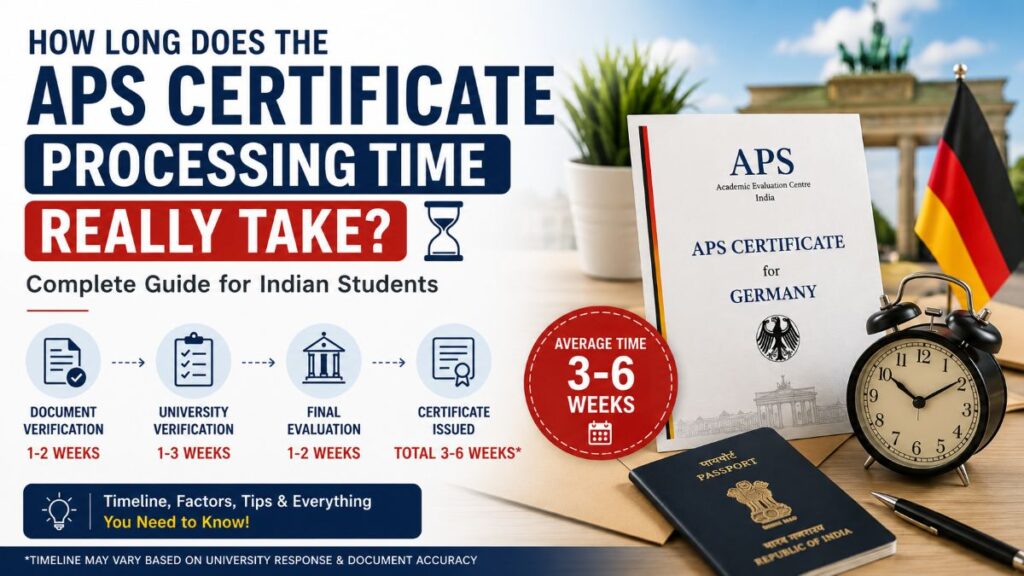
APS Certificate Processing Time: Indian Student Guide Uniplus Overseas — Germany Spoke Update Supporting Spoke · Timeline Guide APS Certificate Processing Time: How Long Does It Really Take? Planning your intake windows correctly requires knowing the exact timeline of your document clearance. Review the standard evaluation phases and typical delay variables below. Standard Window 3 – 6 Weeks From couriered package arrival Verification Mode Digital DigZert Sent directly via consular mail By Uniplus Editorial Board | Fact-Checked Operational Timeline 📅 Updated: July 2026 Need Urgent Verification Help? If you are facing tracking roadblocks or need direct help structuring your documentation package to avoid timeline extensions, you can visit our local Germany Education Consultancy in Hyderabad for face-to-face assistance. 📘 Looking for the complete process, strict eligibility rules, updated fees, and comprehensive FAQs? Read our comprehensive APS Certificate for Germany Guide. Calculating the exact **APS Certificate processing time** is a critical factor for Indian students mapping out university application windows. Under normal operating conditions, the Academic Evaluation Centre in New Delhi completes verification within **3 to 6 weeks**. However, structural changes in stream mandates can introduce variance into this baseline window. For example, applications submitted during peak seasonal intake frames—specifically around the closing dates for the Winter and Summer semesters—naturally experience higher queues. Consequently, initiating your application early is the safest method to protect your admission plan. The Internal Verification Phases Explained To understand why the pipeline takes multiple weeks, we must break down the workflow after your physical documentation parcel arrives at the New Delhi consular gate. The evaluation board reviews your files through a highly structured sequence: 1 Data Logging and Fee Match (Days 1–5) The administration opens your couriered package to confirm that the physical contents match the online form. Next, they match your profile against the ₹18,000 transaction log. 2 Institutional Inquiry (Days 5–20) The evaluation board contacts your home university registrar or secondary school board directly via secure electronic channels. They request formal confirmation that your transcripts are real. 3 DigZert Generation (Days 20–30) Once your university validates your marks, the embassy prints and locks your digital verification certificate, sending it straight to your email account. Common Triggers That Extend Your Processing Time While the standard roadmap finishes in under a month, minor filing mistakes can stall your portfolio for weeks. For instance, the most common roadblock stems from slow institutional responses. If your Indian university takes a long time to answer the embassy’s confirmation mail, your file stays paused indefinitely. Filing Scenario Estimated Window Primary Impact Factor Perfect Portfolio 3 – 4 Weeks Rapid university digital verification reply. Peak Admission Season 5 – 8 Weeks High consular file volumes from May to July. Institutional Delays 6 – 12 Weeks University registrar requires physical follow-ups. Typo/Name Mismatch File Frozen Requires a legal affidavit to resume processing. Therefore, letting your college examination desk know about your application in advance is highly recommended. By alerting them to look out for the embassy’s inquiry, you can significantly accelerate the response cycle. Furthermore, ensuring that you submit individual semester mark sheets instead of just a single consolidated transcript prevents immediate sorting blocks. Strategic Intake Timing for 2026 and 2027 To guarantee that your document lands before university portals close, you must structure your timeline backwards. For the Winter Semester intake, you should ideally submit your physical package no later than March. For the Summer Semester intake, aiming for a September submission provides a safe cushion. Finally, keep in mind that modifying your issued digital certificate file in any way will invalidate it. Do not combine the PDF or change its file name, as doing so breaks the digital signature. For a complete look at how this timeline aligns with your broad application journey, visit our central Study in Germany Guide. Cluster Hub Link This supporting article links directly to our central authority guides: 🔗 Master APS Hub Page Content Audit Monitored weekly against circulars issued by the Academic Evaluation Centre New Delhi. © 2026 Uniplus Overseas. Built alongside verified operational timelines from the German Embassy New Delhi networks. uniplusoverseas.com
Australia Scholarships for Indian Students 2027 : Complete Guide
Australia Scholarships for Indian Students 2027 | Uniplus Home / Study in Australia / Top Scholarships 2027 UNIPLUS OVERSEAS • AUSTRALIA SCHOLARSHIPS GUIDE 2027 Australia Scholarships for Indian Students 2027: Fully Funded & Merit-Based Guide This Australia Scholarships for Indian Students guide covers the best fully funded and merit-based scholarships available for the 2027 intake. Learn about government scholarships, university scholarships, eligibility, funding, deadlines, and how to apply successfully. Published: 30 June 2026 11 min read Scholarships & Funding Book Free Consultation See Government Awards ↓ Government Scholarships University Scholarships IELTS & Eligibility Deadlines Application Process Tips Frequently Asked Questions Related Australia Guides References Securing reliable financial aid is a critical phase of planning your education abroad. When analyzing available options, Australia scholarships for Indian students stand out as some of the most well-funded options in the international higher education ecosystem. Both federal authorities and high-ranking academic institutions continuously expand their financial portfolios to welcome top-tier applicants from across the Indian subcontinent. If you have not yet completed your institutional selection process, we highly recommend utilizing our strategic review of the top universities in Australia for Indian students alongside our detailed breakdown of the total cost of studying in Australia. Aligning your academic roadmap with historical financial data will significantly optimize your entry profiles before deadlines begin to close. Government Scholarships Best Australia Scholarships for Indian Students Federally funded financial programs present comprehensive coverage plans for qualifying postgraduates. In these structural systems, administrative allocations prioritize application streams coming directly out of India. Scholarship Program Academic Level Annual Stipend / Value IELTS Band Minimum Australia Awards Scholarships Master’s & PhD Full tuition + ~A$32,000–35,000 6.5 overall, 6.0 each band Research Training Program (RTP) Research Master’s & PhD Full fee offset + ~A$32,192 stipend University-specific, typically 6.5 Destination Australia Program Any level, regional campuses Up to A$15,000 Set by host institution Applications for the primary government Australia scholarships for Indian students run on strict annualized cycles. Open windows generally launch in February and close toward the end of April of the preceding calendar year. Because selection phases operate via the Australian High Commission in New Delhi, files must move through the official online OASIS database portal. Strategic Planning Profile Shortlist Review Let us match your profile to the right mix of government and university scholarships before deadlines close. Book Free Consultation → Institutional Funding University Australia Scholarships for Indian Students The country’s prominent Group of Eight (Go8) institutions manage highly competitive financial networks. Most profiles automatically trigger a merit assessment when complete entry documentation is logged. Go8 · VIC University of Melbourne Melbourne Graduate Research Scholarship (MGRS) Covers full tuition plus a living allowance of around A$39,500 a year for research master’s and PhD candidates. The undergraduate-level International Undergraduate Scholarship now offers 20% fee sponsorship for 225 students from 2027, down from 25% but with more places available. Research + UGAuto-assessed (UG)Deadline: 31 Oct 2026 Go8 · VIC Monash University Monash RTP & Merit Scholarship The Monash RTP covers full tuition plus a living allowance of roughly A$37,145, a relocation allowance, and a research allowance for postgraduate research students. The Monash International Merit Scholarship offers around A$10,000 a year off coursework tuition. Research + CourseworkAuto-assessedRolling deadline Go8 · NSW University of Sydney USYDIS & Vice-Chancellor’s International Scholarship The University of Sydney International Stipend Scholarship (USYDIS) is worth roughly A$42,754 a year for research candidates. For coursework students, the Vice-Chancellor’s International Scholarships Scheme now offers tiers up to A$60,000 for 2026 and 2027 intakes, awarded on academic merit alone. Research + CourseworkAuto-assessedAssessed quarterly Go8 · NSW UNSW Sydney UNSW International Award & Scientia Scholarship The UNSW International Award gives a flat 20% tuition contribution for every year of study for students from eligible countries starting in 2026 or 2027. The more competitive Scientia Coursework Scholarship adds up to A$10,000 a year on top, and can be combined with the International Award. CourseworkAuto-assessedNo separate form Go8 · ACT Australian National University (ANU) ANU Chancellor’s International Scholarship ANU offers a tuition reduction typically ranging from 25% to 50%, awarded on the strength of your academic transcript at the time of application, with no separate scholarship form required. ANU is also a strong pathway into Commonwealth-linked research funding, including RTP-supported PhD places in STEM and public policy fields. Undergrad + PostgradAuto-assessedRolling, by round To secure entry into any highly competitive university Australia scholarships for Indian students, maintaining a stellar transcript through your last two years of study remains paramount. Always confirm secondary faculty quotas before submission. Admissions Thresholds IELTS Requirements & General Eligibility English proficiency is usually assessed as part of your admission file rather than as a separate scholarship requirement, but most scholarship-eligible offers sit at the higher end of each university’s IELTS band. Typical IELTS Bands Undergraduate coursework: 6.0–6.5 overallPostgraduate coursework: 6.5 overall, 6.0 each bandResearch degrees (MGRS, USYDIS, RTP): 6.5 overallSome scholarships accept PTE or TOEFL equivalents Common Academic Thresholds Distinction average (75%+) for Go8 merit scholarshipsGPA equivalent of roughly 3.5/4.0 for Scientia-tier awardsNo active academic backlogs at time of applicationStrong performance in your final two years weighted heavily Useful Flexibility UNSW accepts applications before final IELTS scores arriveMost merit scholarships use automatic considerationGovernment awards weigh leadership alongside academicsSome scholarships allow stacking with other awards Deadlines Registry 2027 Intake Scholarship Deadlines Government deadlines fall earliest in the calendar, so the safest approach is to start preparing a full year before your intended intake. Scholarship Window Opens Deadline / Notes Australia Awards (2028 intake) Feb 2027 Late April 2027 Melbourne Intl. Undergraduate Scholarship With course application 30 Nov 2026 (Sem 1 2027) Sydney USYDIS (research periods 1–2, 2027) With course application 11 Sep 2026 Sydney USYDIS (research periods 3–4, 2027) With course application 18 Dec 2026 UNSW International Award & Scientia Rolling Assessed on admission, apply early ANU Chancellor’s Scholarship Rolling, by round Assessed on admission Strategic Workflow How to Apply, Step by Step 1 Submit a complete, certified admissions application Most university merit scholarships are assessed from the same file you use
Australia Student Visa Guide : Subclass 500 Visa
Australia Student Visa Requirements for Indian Students 2027: Subclass 500 Guide Uniplus Overseas — Australia Study Guide Updated for 2026–27 Evidence Level 3 Australia Student Visa Guidefor Indian Students (2027) A definitive 2026–27 Subclass 500 processing dossier—detailing the Genuine Student requirement, Evidence Level 3 compliance rules, visa fees, and timelines for your upcoming intake. Last updated: January 2026 Visa fee A$2,000 Processing time 8–10 weeks (EL3 scrutiny) Reading time ~11 minutes Policy Scrutiny Update: The Department of Home Affairs has updated updates regarding India’s assignment within the Student Visa Framework, designating the processing track under Evidence Level 3 high-scrutiny guidelines. This active dossier reflects the comprehensive upfront criteria required under this standard. Share this guide WhatsApp LinkedIn X On this page ▾ 01 Framework Introduction 02 Application Timelines 03 Genuine Student Mandate 04 Evidence Level 3 Criteria 05 Fees & Fiscal Liquidity 06 Mandatory Document Checklist 07 Mitigating Refusal Vulnerabilities 08 In-Country Work Provisions 09 Frequently Asked Questions ⚡ Core Visa Summary ✔Visa Category: Subclass 500 Student ✔Lodgement Cost: A$2,000 ✔Scrutiny Period: 8–10 weeks (Evidence Level 3) ✔Work Cap: 48 hours per fortnight during term ✔Grant Terms: Aligned to course registration metrics ✔English Metric: IELTS 6.0+ or equivalent benchmark ✔Living Capacity: A$29,710 annual proof threshold ✔Lodgement Path: DHA ImmiAccount Web Portal A$2,000 DHA Visa Fee 8–10 Wks EL3 Processing 48 Hours Fortnightly Work A$29,710 Living Metric 🛂Strategic Context Navigating the Australia Student Visa Subclass 500 Process The Subclass 500 visa stands as the unified regulatory vehicle dictating temporary residency authorization for almost all non-domestic students navigating higher education pathways in Australia. Recent policy updates have significantly transformed the compliance landscape: the legacy Genuine Temporary Entrant (GTE) written essay model has been completely replaced by the targeted Genuine Student (GS) structured query framework, and documentation evaluation tracks emphasize strict criteria under operational Evidence Level 3 rules. If you are finalizing your institutional placement profile, coordinate your options alongside our extensive analysis of the top universities in Australia for Indian students, and accurately crosscheck your financial commitments through our breakdown tracking the cost of studying in Australia. Once your enrollment track is established, follow this structured blueprint to complete your application. Regulatory Notice: This operational manual maps policy criteria dictated by the Department of Home Affairs (DHA). Because international student assessment parameters, statutory application costs, and processing pipelines undergo cyclical administrative revisions, verifying immediate constraints via immi.homeaffairs.gov.au remains mandatory before lodging materials. 🗺️Operational Roadmap Step-by-Step Australia Student Visa Application Blueprint Achieving a predictable adjudication path requires strict alignment with the mandated chronological sequencing of the Department of Home Affairs framework. 1 Pre-Lodgement Stage Institutional Matriculation and CoE Issuance Upon accepting your university offer and transferring the initial tuition fees, your hosting campus logs your enrollment to generate your official Confirmation of Enrolment (CoE). The CoE is a fundamental requirement; digital submission protocols systematically prevent visa application creation without an active registration record. 2 Pre-Lodgement Stage Overseas Student Health Cover (OSHC) Procurement Compulsory health policy coverage must be active and fully paid prior to visa submittal, covering the entire duration of your proposed educational tenure. Annual premium benchmarks generally range between A$500 and A$700 for individual student lines, varying based on the commercial carrier selected. 3 Lodgement Stage ImmiAccount Provisioning and Structured GS Response Input Applicants must answer four clear, structured Genuine Student queries integrated into the online web form, with each response strictly limited to a 150-word maximum. Because this text serves as the core evaluation tool for intent verification, avoid boilerplate answers and use precise, verified facts instead. 4 Lodgement Stage Evidence Level 3 Mandatory Document Attachment Given the specific scrutiny criteria applied to processing frameworks, you must include verifiable evidence regarding liquid funds and standardized language diagnostics directly upon application upload. This framework requires providing a clear three-to-six-month transactional bank history rather than just sudden, unverified single deposits. 5 Lodgement Stage DHA Processing Charge Remittance The standard processing charge for a primary Subclass 500 applicant is set at A$2,000, collected online through integrated portal payment systems at the exact point of upload. This processing charge is non-refundable, regardless of whether the visa is granted or refused. 6 Post-Lodgement Stage Biometric Enrollment and Panel Medical Evaluation Applicants are systematically scheduled to register structural biometric profiles at authorized collection locations and complete comprehensive physical diagnostic checks managed by designated panel physicians. Booking these appointments early is critical to avoiding extended delays during high-volume periods. Post-Lodgement Exceptions through Final Adjudication 7 Post-Lodgement Stage Accelerated Response to Requests for Information (RFI) If an evaluating officer identifies a documentation gap or requires clarification, they will issue a formal Request for Information (RFI) inside your account space. Slow or incomplete responses to these alerts are a leading cause of long delays, making immediate action essential. 8 Adjudication Stage Visa Grant Issuance and Travel Logistics Activation Upon satisfactory determination of your application, your formal digital Grant Notification letter is updated on the portal. Once this document is issued, you can finalize flights, secure your housing arrangements, and plan your arrival details. Pre-Submission Quality AssuranceProtect your application from common errors by having our verification team audit your GS responses and evidence layout against current compliance rules. Schedule Free Consultation Now → 🎓Intent Verification The Genuine Student (GS) Evaluation Framework Every Subclass 500 assessment is processed through the structured Genuine Student screening framework. Rather than evaluating a general personal statement, case officers use four distinct, targeted fields to analyze intent. Each response is strictly limited to 150 words inside the portal application interface. Target Field 1 Domestic Socio-Economic Circumstances Detail your current family background, active community connections, economic stability, and employment history in India. This section must establish verifiable incentives that ensure a logical return home after graduation. Target Field 2 Academic Rationale and Provider Selection Explain the precise educational reasons behind choosing this specific course of study and host campus. Your response should show clear research into academic structures and the realities of living in Australia. Target Field 3 Professional Value and Career Path Mapping Connect this
Study Renewable Energy Abroad : Best Countries & Careers

Study Renewable Energy Abroad 2027 | Best Countries, Universities & Careers | Uniplus Overseas Home / Career Guides / Study Renewable Energy Abroad Uniplus Overseas · Study Abroad Guide 2027 Study Renewable Energy Abroad: Best Countries, Universities & Careers for Indian Students Germany, Australia, Denmark, Sweden, Canada and the Netherlands are racing to build the clean-energy workforce of the next decade. Here’s how to pick the right country, course and university before you apply. Last Updated: 30 June 2026 8 min read Career Guides Book a Free Counselling Session Compare Countries ↓ Why Study This Best Countries Universities Courses Tuition Scholarships Visa Careers FAQs Related Guides References The Global Clean-Energy Transition The world is currently undergoing the largest industrial energy shift in a century. Because governments worldwide have formally committed to Net Zero targets, trillions of dollars are now flowing into solar, wind, battery storage, and green hydrogen infrastructure. Consequently, countries like Germany, Australia, Denmark, Sweden, Canada, and the Netherlands are investing billions in renewable energy. As a result, renewable energy companies are creating a fast-growing demand for engineers, sustainability professionals, and climate technology specialists who can design, build, and manage this infrastructure. Our comprehensive study abroad guide framework highlights the distinct structural shifts that make this sector highly lucrative for international applicants. Because governments aggressively support clean-tech integration, traditional technical pathways are facing structural saturation, whereas clean energy stands out as a high-demand alternative with favorable work rights and structural job growth. International training provides access to world-class research labs, live regional test environments, and forward-thinking post-study job markets. Therefore, prioritizing this specialization balances your academic goals with active global talent shortages. In addition, our advisors regularly update these parameters to ensure that your international academic planning remains accurate. By checking the detailed breakdowns below, you will understand exactly why this field is expanding, which countries lead in each specialization, what courses to expect, and how to maximize your employment prospects with confidence. Furthermore, this blueprint outlines the specific technical skills required to pass competitive corporate recruitment screenings. Why This Field Why Study Renewable Energy Abroad? Renewable energy isn’t just one career path — it’s a cluster of fast-growing specializations, each with its own demand curve and distinct skill set. Key Segments in the Global Clean-Tech Landscape To understand the depth of this sector, it helps to analyze the distinct structural areas driving industrial expansion. Consequently, technical training yields exceptional career diversity because positions span several high-growth engineering channels. Moreover, mastering these systems ensures long-term professional adaptability as corporate energy compliance grids expand globally. For example, data analytics and hardware implementation are merging into entirely unique operational fields. Global Net Zero Transition Government targets lock in decades of structural spend. Thus, hiring remains highly sustained rather than cyclical. Solar Engineering Specialist Photovoltaic design, manufacturing, and smart grid-integration roles are expanding rapidly across global sunlight markets. Wind Energy Engineering Onshore and offshore marine projects need turbine design, fluid dynamics, and grid-connection specialists. Green Hydrogen Sector This emerging frontier combines advanced chemical engineering with smart systems for heavy industrial decarbonization. ESG & Sustainability Compliance Companies worldwide need certified corporate analysts who can navigate complex environmental reporting and governance regulation. Battery & Storage Technology High giga-factory investments are driving demand for materials scientists and complex storage system layout engineers. Electric Vehicle Infrastructure Rapid EV adoption pulls engineering graduates into fleet logistics, charging grids, and supply chain management. AI & Smart Grid Analytics Grid operators use machine learning algorithms for demand forecasting, creating an ideal overlap with data careers. Where To Apply Best Countries to Study Renewable Energy Each destination leads in a different specialization. Match your interest area to the right country before shortlisting universities. Best Renewable Energy Destinations in Europe Although every destination offers renewable energy programs, each country specializes in different technologies. Germany leads in hydrogen and solar research, Denmark excels in offshore wind, while Australia focuses on large-scale renewable infrastructure. Consequently, you can easily align your academic goals with local job markets. Germany Overview Excellent jobs Germany remains Europe’s primary clean energy research hub, offering world-renowned public university programs with low or zero tuition fees. Additionally, the country excels in solar energy frameworks, advanced grid scaling, and green hydrogen supply chain development. Interested in testing alternative options? Explore our localized resources via the Germany Study Guide and Germany Scholarships directories. Top Specialization Solar Engineering & Hydrogen Infrastructure Stay-Back Advantage 18-month post-study job-seeking visa Study in Germany Scholarships Australia Overview Strong jobs Likewise, Australia features expansive solar installations and massive regional utility investments, making it an excellent destination for large-scale grid management studies. In addition, if Australia is your preferred destination, explore our Study in Australia, Top Universities in Australia, and Cost of Studying in Australia guides before shortlisting universities. Top Specialization Microgrids, Solar Farms, & Energy Logistics Stay-Back Advantage Favorable post-study work paths for regional grads Study in Australia Top Universities Cost Guide Scholarships Wind Energy & Sustainability Leaders Northern European nations lead the world in turbine grid integration and progressive circular economy planning systems. **Overall,** these regions provide highly targeted industry environments for engineering candidates. Denmark Overview Excellent jobs Furthermore, Denmark is a world pioneer in wind power engineering, generating a massive portion of its electricity from coastal and marine wind arrays. **Moreover,** it is home to global wind manufacturing leaders, offering international students unparalleled industrial project exposure. Top Specialization Offshore Wind Systems & Aerodynamics Stay-Back Advantage Favorable European green-card stay options Study in Europe Sweden Overview Excellent jobs Similarly, Sweden stands at the forefront of circular economic models, waste-to-energy conversion, and high-tech vehicle battery cells. **As a result,** studying here provides direct industry connections to major gigafactories and highly integrated sustainable urban planning initiatives. Top Specialization Battery Tech, E-Vehicles, & Circular Systems Stay-Back Advantage Favorable paths for tech and sustainability specialists Study in Europe North American Opportunities & Systems Management Canada continues to invest heavily in hydroelectricity, smart grids and clean-energy research. Students looking for North American opportunities should compare Canadian universities with Australian and European
Cost of Studying in Australia for Indian Students

Cost of Studying in Australia for Indian Students (2027 Guide) | Uniplus Overseas Uniplus Overseas — Australia Study Guide Updated for 2027 intakes Cost of Studying in Australiafor Indian Students A 2027 budgeting dossier — tuition, rent, visa fees, and OSHC, broken down city by city so you know the real number before you apply. Total annual range A$45,000 – A$90,000+ Visa fee (2026) A$2,000 Reading time ~9 minutes The Real Number What does the cost of studying in Australia actually add up to? For most Indian students, the total cost of studying in Australia falls between A$45,000 and A$90,000 per year, once tuition, rent, food, transport, insurance, and visa charges are all counted together. However, that range hides a lot of variation. A student at a Group of Eight university in Sydney and a student at a non-Go8 university in Adelaide can end up paying nearly double the difference, simply because of where they chose to study. Before this guide, you may have already read our overview on studying in Australia for Indian students in 2027 or compared institutions in our breakdown of the top universities in Australia for Indian students. This guide picks up from there and answers the question both of those leave open: what will it actually cost you, line by line? Average annual tuition feeBachelor’s or Master’s, most universities A$22,000 – A$50,000 Average annual living costRent, food, transport, utilities A$18,000 – A$30,000 One-time visa and insurance costsSubclass 500 fee + OSHC for one year A$2,500 – A$2,700 Typical first-year totalTuition + living + visa + OSHC, combined A$45k – A$83k These figures are indicative 2026–27 estimates compiled from Australian Department of Home Affairs guidance and published university fee schedules. Because fees are reviewed annually and vary by course, you should always confirm the exact number for your program on the university’s official fees page before budgeting. Cost Driver #1 Tuition fees by degree and field Tuition is the single biggest line item in the cost of studying in Australia, and it varies enormously depending on your degree level and field. For example, a humanities bachelor’s degree can cost less than half of what an MBA or a medical degree costs in the same city. Bachelor’s degree (per year)A$20,000 – A$52,000 Master’s coursework (per year)A$22,000 – A$50,000 MBA (full program)A$60,000 – A$95,000 Medicine / Dentistry (per year)A$65,000 – A$85,000 Foundation / pathway programsA$36,000 – A$39,000 VET diploma (per year)A$12,000 – A$28,000 A few patterns are worth planning around, because they affect your total cost more than any single fee figure: Go8 universities sit at the higher end of every band, since prestige and research funding both feed into the sticker price. Non-Go8 universities such as Macquarie and UTS typically charge 15–30% less for comparable programs, without a meaningful drop in teaching quality. Because fees are indexed annually, you should budget for a modest year-on-year increase across a multi-year degree, not just the first-year figure. Therefore, the listed price for Year 1 is rarely the final price for Year 3 — always ask the university for its indexation policy in writing. Course-Level Fee CheckWant the exact fee for your specific course, not just the average band? We’ll pull it from the official source before you apply. Get My Fee Breakdown → Cost Driver #2 Living costs by city: where you study changes everything Although tuition gets most of the attention, your choice of city is often what actually decides whether the cost of studying in Australia feels manageable or overwhelming. Sydney and Melbourne carry a real premium; Adelaide, Perth, and Brisbane do not. Sydney Most expensive A$2,200 – $4,000+ Monthly living cost, all categories combined Shared room: A$300–450/week Highest rent and transport costs nationally Largest graduate job market in finance and tech Melbourne Second most expensive A$1,900 – $3,800 Roughly 10% cheaper than Sydney overall Shared room: A$250–400/week Strong consulting and business hub Large international student community Brisbane Balanced option A$1,800 – $3,200 Subtropical city, moderate rent growth Shared room: A$180–250/week Lower cost of living than Sydney or Melbourne Growing tech and biotech job market Adelaide Most affordable major city A$1,400 – $2,800 16% cheaper than Sydney, 13% cheaper than Melbourne Shared room: A$180–250/week Tiered Go8 fee discounts available at Adelaide University Known as Australia’s food capital Perth Affordable, resource-sector jobs A$1,800 – $3,300 Lower living costs, strong mining-sector salaries Shared room: A$180–250/week Qualifies as regional for some visa and PR purposes Home to UWA, the state’s top-ranked university Hobart Cheapest overall ~A$2,500/month Consistently ranks as Australia’s lowest-cost student city Significant savings on rent versus mainland cities Smaller course range, mostly at the University of Tasmania Best fit for highly budget-conscious applicants City living-cost ranges are drawn from the Study Australia government cost-of-living calculator and current city-level student budgeting data, and are indicative only. Your actual spend will depend on your accommodation type, lifestyle, and shared versus private housing choices. Mandatory Costs Visa, insurance, and other costs you cannot skip Beyond tuition and rent, a handful of costs are mandatory for every international student in Australia, regardless of university or city. Because these are fixed obligations rather than lifestyle choices, you should treat them as non-negotiable lines in your budget. Item Cost When it’s paid Student visa (Subclass 500) A$2,000 Before arrival, non-refundable Overseas Student Health Cover (OSHC) A$500 – $700/yr Before visa lodgement, for full course duration Minimum living cost evidence (DHA) A$29,710/yr Shown as proof of funds, not a direct payment Enrolment / acceptance deposit A$200 – $5,000 After accepting your offer Student services & amenities fee A$300 – $1,000/yr Billed by the university annually Health examination (if required) A$300 – $500 Before visa approval Visa and insurance figures reflect Department of Home Affairs charges current as of 2026, including the Subclass 500 fee increase to A$2,000 effective 1 July 2025. Since these figures are reviewed periodically, you should confirm the current charge at immi.homeaffairs.gov.au before lodging your application. Day-to-Day Spend What a typical month actually costs Once you are settled, your monthly budget
Top Universities in Australia for Indian Students
Top Universities in Australia for Indian Students (2027 Guide) | Uniplus Overseas Uniplus Overseas — Australia Study Guide Updated for QS 2027 Top Universities in Australiafor Indian Students A 2027 rankings dossier — QS positions, tuition fees, scholarships, intakes, and how to actually choose between them. Universities in top 100 9 globally ranked Best for UG · PG · MBA applicants Reading time ~10 minutes Why this list, why now Australia just had its strongest QS year on record According to the QS World University Rankings 2027, UNSW Sydney has overtaken the University of Melbourne to become Australia’s top-ranked university for the first time. As a result, this is a historic shift that matters if you are choosing where to apply. In fact, nine Australian institutions now sit inside the global top 100, and six Group of Eight universities rank in the world’s top 40. However, if you are still deciding whether Australia is the right destination at all, you should first read our complete guide to studying in Australia for Indian students in 2027. After that, you will be ready to dive into the university-by-university comparisons below. For Indian students, though, the decision is not just about “which university is famous.” Instead, it comes down to rank, fee, course strength, scholarship access, and a realistic post-study pathway, all weighed together. Therefore, this guide puts all five side by side for the ten universities that Indian applicants shortlist most often. 19th UNSW Sydney’s new global rank — Australia’s highest ever 8/8 Group of Eight universities now inside the world top 80 A$45k+ Typical annual Go8 undergraduate tuition fee The case for Australia Why Indian students keep choosing Australian universities In addition to rankings, four things consistently bring Indian students to Australian campuses over other destinations. Global standing Nine universities in the QS world top 100 and an average academic-reputation score ahead of the US, UK, and Canada. Graduate employability Strong employer-reputation scores across the Group of Eight, with degrees built around industry partnerships. Research strength Six universities rank in the global top 50 for academic reputation, with deep ties to Horizon Europe and global research networks. A genuinely multicultural campus 11 universities rank in the world’s top 100 for international faculty — classrooms built for global students, not an afterthought. Work rights while studying Student visa holders can work part-time during term and unlimited hours during scheduled breaks. Two real intakes February and July both run full-scale, so a missed deadline rarely means losing a whole year. Free Profile ReviewNot sure if your profile fits a Go8 university or a strong mid-tier one? Get a straight answer before you spend on applications. Book a Free Consultation → The Shortlist Top 10 universities in Australia, ranked Below are the QS World University Rankings 2027 positions, along with what each university is actually known for, what it costs, and what it asks of you at the door. The Group of Eight universities 19World University of New South Wales (UNSW Sydney) Sydney, NSW · Australia Rank #1 Group of Eight QS World Rank19th (up from 49th in 2017) Annual Fees (UG)~A$45,000–52,000 MBA (AGSM)~A$88,000 total IELTS6.5 overall (6.0 min/band) Popular courses Engineering & Computer Science Business (AGSM) Law & Justice Medicine & Health Why it jumped to #1 UNSW’s climb to Australia’s top spot was driven mainly by strong employment-outcomes and sustainability scores — not a single headline metric, but consistent improvement across the board. Scholarships Faculty-specific international scholarships plus the AGSM MBA scholarship pool; need to apply separately from the admission application. 22World University of Melbourne Melbourne, VIC · Australia Rank #2 Group of Eight QS World Rank22nd Bachelor of Commerce~A$46,000/yr Melbourne Business School MBA~A$95,000 IELTS6.5 overall Popular courses Medicine & Dentistry Law & Education Business & Management Architecture & Psychology Campus highlight Australia’s most internationally recognised brand name, with deep alumni networks across consulting, law, and medicine in India. Scholarships Melbourne International Undergraduate and Graduate Research Scholarships, both merit-based and competitive. 28World University of Sydney Sydney, NSW · Australia Rank #3 Group of Eight QS World Rank28th Doctor of Dental Medicine~A$82,000/yr Foundation Program~A$39,000 (12 mo) IELTS6.5 overall Popular courses Medicine & Dentistry Engineering & IT Arts & Social Sciences Architecture Campus highlight Australia’s oldest university, with a sandstone main campus and one of the largest international student communities in the country. Scholarships The University of Sydney International Scholarship offers a 50% tuition reduction to up to 100 students per year. 29World Australian National University (ANU) Canberra, ACT · Australia Rank #4 Group of Eight QS World Rank29th Typical PG Fee~A$42,000–48,000/yr CityCanberra (capital) IELTS6.5 overall Popular courses Law & Philosophy Politics & Development Studies Earth & Marine Sciences International Relations Campus highlight Located in Australia’s capital, with close ties to government, federal policy bodies, and international organisations — strong for political science and public policy aspirants. Scholarships ANU offers dedicated merit-based international scholarships, with strong allocation for research-track postgraduate students. 31World Monash University Melbourne, VIC · Australia Rank #5 Group of Eight QS World Rank31st (strongest ever) Merit ScholarshipA$10,000/yr Monash College Diploma~A$36,000 IELTS6.5 overall Popular courses Pharmacy & Medicine Engineering Business & IT Data Science Campus highlight One of Australia’s largest universities by enrolment, with a dedicated pathway college (Monash College) that’s popular among Indian students entering via diploma routes. Scholarships Monash International Merit Scholarship offers A$10,000 per year to high-achieving undergraduates, renewable across the degree. 40World University of Queensland (UQ) Brisbane, QLD · Australia Rank #6 Group of Eight QS World Rank40th (No.1 in Brisbane) Bachelor of Arts~A$34,000/yr Excellence Scholarship25% fee reduction IELTS6.5 overall Popular courses Engineering & Veterinary Science Pharmacy & Agriculture Environmental Sciences Dentistry Campus highlight Brisbane’s top-ranked university, linked to two Nobel laureates (Peter C. Doherty and John Harsanyi) — a strong choice for research-heavy science and agriculture programs. Scholarships UQ Excellence Scholarship gives a 25% tuition reduction to students with an ATAR-equivalent of 95 or higher. 77World University of Western Australia (UWA) Perth, WA · Australia Rank #7 Group of Eight QS World Rank77th (top in Perth)
Study in Australia for Indian Students in 2027: Complete Guide
Study in Australia for Indian Students in 2027: Complete Guide Planning to study in Australia for Indian students has become one of the most effective ways to build a highly competitive global career. Because Australian institutions seamlessly combine premium academic programs with exceptional lifestyle advantages, thousands of international applicants target this destination every year. Consequently, navigating your choices carefully across university rankings, intake deadlines, and visa regulations is essential for success. This master guide delivers a complete overview to help you successfully map out your future parameters for the upcoming 2027 entry cycle. Quick Answer: Why Study in Australia? Choosing to study in Australia for Indian students offers unmatched long-term benefits. Key structural highlights include: Top-Ranked Universities: Access to the famous Group of Eight (Go8) research institutions. Practical Course Styles: Programs designed in direct coordination with global corporate partners. Lucrative Grants: Institutional fee waivers covering 10% to 50% of annual tuition fees. Post-Study Work Rights: Clear pathways to gain local industry training after graduation via subclass 485. Key Academic Benefits Down Under First and foremost, qualifications earned here are protected through the Australian Qualifications Framework (AQF). This strict national system ensures your degree carries immense prestige when evaluated by multinational companies worldwide. Furthermore, local universities are globally celebrated for pioneering research breakthroughs, such as Wi-Fi networks and ultrasound tech. Therefore, students are directly integrated into an ecosystem that values hands-on practical learning over theoretical textbook formats. Top Universities in Australia for Indian Students To organize your strategy for the 2027 academic intakes, you must analyze how the leading institutions align with your budget. This verified layout displays premium Group of Eight (Go8) hubs alongside top-tier technology networks: University Name Group Allocation Indicative Annual Fees (AUD) Popular Course Strengths Key Available Funding University of Melbourne Group of Eight (Go8) AUD 42,000 – 48,000 Computer Science, MBA, Data Science Melbourne International Undergraduate University of Sydney Group of Eight (Go8) AUD 41,000 – 47,000 Engineering, Business Analytics, Law Vice-Chancellor’s International Australian National University Group of Eight (Go8) AUD 40,000 – 46,000 Cyber Security, Physics, Public Policy ANU Chancellor’s International UNSW Sydney Group of Eight (Go8) AUD 41,000 – 46,000 Artificial Intelligence, Engineering UNSW Future International University of Queensland Group of Eight (Go8) AUD 39,000 – 45,000 Biotechnology, Environmental Science UQ Excellence Scholarships Monash University Group of Eight (Go8) AUD 38,000 – 44,000 Pharmacy, Data Science, Nursing Monash International Merit University of Western Australia Group of Eight (Go8) AUD 37,000 – 43,000 Marine Science, Mining Engineering Global Excellence Scholarship University of Adelaide Group of Eight (Go8) AUD 36,000 – 42,000 Wine Marketing, Computer Science Global Citizens Scholarship UTS (University of Technology Sydney) Non-Go8 (Tech Network) AUD 34,000 – 39,000 Cyber Security, Business Analytics UTS Vice-Chancellor’s Merit RMIT University Non-Go8 (Tech Network) AUD 33,000 – 38,000 Art & Design, Master of Data Science RMIT International Student Award High-Demand Disciplines for 2027 Selecting the right course stream is critical to maximize your global career opportunities. Currently, the most sought-after programs include: Computer Science & Cyber Security: Programs focusing heavily on cloud network defenses, secure software architecture, and corporate infrastructure management. Artificial Intelligence & Data Science: High-velocity training tracks that cover machine learning, predictive data models, and advanced database analytics. MBA & Business Analytics: Elite management streams designed to bridge corporate boardroom strategies with modern data architectures. Nursing & Healthcare Management: Heavily regulated programs providing extensive hands-on hospital placements and clinical experience. Analyzing the Cost of Studying in Australia Tuition and Living Fees Your absolute financial investment depends primarily on your institution’s tier and your choice of city. Specifically, regional locations like Adelaide or Hobart generally offer much lower accommodation outlays compared to downtown Sydney or Melbourne. To ensure total financial readiness, students must evaluate tuition scales alongside healthcare premiums and daily transit options. Learn more about these specific requirements via our upcoming detailed dashboard: Cost of Studying in Australia. Unlocking Australia Scholarships for Indian Students Are you looking to minimize your tuition outlays? Fortunately, competitive applicants can target a variety of funding pools, including Destination Australia regional grants and automatic university merit awards. To review specific score thresholds, entry parameters, and timeline schedules, read our future comprehensive breakdown: Australia Scholarships for Indian Students. Navigating the Student Visa Architecture The Subclass 500 Framework Securing your student visa requires satisfying a strict, document-backed assessment. Under current guidelines, applicants must pass the Genuine Student (GS) evaluation, which examines your academic background, home ties, and career progression logic. Additionally, immigration rules dictate that you must display liquid proof of financial capacity. Specifically, you need access to at least **AUD 29,710 per year** to cover mandatory living allowances. To plan your documentation checklist without errors, check out our upcoming roadmap: Australia Student Visa Guide. Understanding the Australian Academic Intakes February versus July Timelines Unlike destinations centered around a single entry window, the Australian system offers two major intake opportunities every year: Semester 1 (February Intake): This is the primary entry window across all campuses. It provides access to all course variants and maximum scholarship pools. Semester 2 (July Intake): This is a highly popular option for Indian graduates finishing exams in June. It allows you to transition directly into your studies without a gap year. To map out your application submission dates accurately, bookmark our detailed scheduling guide: Australia Intakes Timeline. Why Indian Students Choose Australia ✔ Work-Term Flexibility: International students can legally work up to 48 hours per fortnight while semesters are in session. ✔ Unlimited Break Hours: You can work full-time hours during official university vacation periods. ✔ Graduate Visa Access: Stay on to acquire crucial international corporate experience after finishing your studies. Frequently Asked Questions (FAQs) Q1: Is Australia safe for Indian students? Yes, Australia is widely recognized as one of the safest study-abroad environments. Major cities provide student safety hubs, active transit safety programs, and multicultural neighborhoods to ensure a smooth transition. Q2: What are the minimum English requirements for an Australian student visa? To secure a standard Subclass 500 Student Visa, applicants generally need a
Top Universities in the UK for Indian Students in 2027

Top Universities in the UK for Indian Students in 2027: Rankings, Fees & Courses Choosing the right UK university is undoubtedly one of the biggest decisions you will make as an international scholar. Consequently, navigating hundreds of elite institutions offering globally recognised degrees can feel significantly overwhelming at first glance. Fortunately, Britain remains a premier destination due to its exceptional graduate employability and unmatched research models. Therefore, identifying the absolute Top Universities in the UK for Indian Students serves as your vital first step toward launching a successful global career path in 2027. Quick Answer: Best Universities in the UK for Indian Students Your ideal study destination depends entirely on your target course, financial parameters, and professional aspirations. Currently, the premier choices include: University of Oxford University of Cambridge Imperial College London University College London (UCL) University of Edinburgh King’s College London University of Manchester University of Warwick University of Bristol University of Glasgow UK University Comparison Table (2027 Entry) To help you map out your higher education journey efficiently, here is a structured overview of the premier destinations across the United Kingdom. This dashboard combines recent academic standings with realistic tuition thresholds: University QS Ranking Annual Tuition Fees (Indicative) Popular Courses Scholarships Available Imperial College London #2 £32,000 – £38,000 Engineering, CS, Medicine President’s Scholarships University of Oxford #4 £28,000 – £37,000 MBA, PPE, Law, Medicine Rhodes, Clarendon University of Cambridge #6 £27,000 – £36,000 Natural Sciences, Engineering Gates Cambridge University College London (UCL) #8 £25,000 – £35,000 Data Science, Architecture UCL Global Masters University of Edinburgh #35 £21,000 – £27,000 AI, Informatics, Arts Edinburgh Global King’s College London (KCL) #37 £23,000 – £31,000 Healthcare, International Relations KCL Sanctuary Awards University of Manchester #40 £22,000 – £28,000 Business Analytics, Engineering Great Scholarships University of Bristol #57 £22,000 – £29,000 Aerospace Engineering, Law Think Big Scholarships University of Warwick #69 £22,000 – £30,000 MBA, Finance, Management Warwick Chancellor’s University of Glasgow #78 £20,000 – £28,000 Computing Science, Medicine International Merit Deep Dive: Top 10 UK Universities for Indian Students 1. Imperial College London As a global powerhouse in STEM, Imperial College London proudly secures the #2 worldwide ranking. Ambitious Indian applicants consistently favor this campus due to its world-class laboratory ecosystems and immediate proximity to London’s thriving commercial tech hubs. Furthermore, standard leading programs include the MSc in Computer Science alongside advanced Biomedical Engineering paths. Currently, annual tuition values average between £32,000 and £38,000. Because graduate starting salaries here rank among the highest in Britain, career prospects remain unmatched. Additionally, competitive merit awards like the Imperial President’s Scholarship can significantly offset costs. 2. University of Oxford Holding the #4 position globally, the historical University of Oxford offers unrivaled academic prestige. International students are drawn to its unique collegiate tutorial system and highly influential global alumni networks. Moreover, popular fields of study prominently include the executive Oxford MBA, corporate Law specializations, and Public Policy. Annual tuition outlays range between £28,000 and £37,000. Consequently, graduates transition seamlessly into elite consulting firms or top-tier international organizations. For exceptional candidates, fully-funded schemes like the Rhodes and Clarendon scholarships provide complete financial coverage. 3. University of Cambridge Ranked #6 worldwide, Cambridge stands as an elite pinnacle for scientific breakthrough and advanced mathematical heritage. Many Indian scholars choose this institution to collaborate directly with industry-linked research teams. In addition, flagship offerings include specialized tracks in Natural Sciences, Advanced Computing, and Structural Engineering. Yearly fees scale between £27,000 and £36,000. Because tech sectors recruit heavily from campus, graduates secure excellent global roles. Finally, the legendary Gates Cambridge scholarship program remains a premier option for high-achieving applicants. 4. University College London (UCL) Securing the prestigious #8 global position, UCL is located directly in the bustling heart of central London. This central setting makes it a favorite destination for Indian applicants seeking a highly cosmopolitan student experience. Specifically, popular course choices include Data Science, urban Architecture, and specialized Economics programs. Annual tuition commitments generally vary from £25,000 to £35,000. Because the university maintains deep corporate tie-ins, career placement rates are robust. Meanwhile, partial funding support is accessible through competitive paths like the UCL Global Masters Scholarship. 5. University of Edinburgh Holding the #35 worldwide rank, the historic University of Edinburgh represents the absolute peak of Scotland’s higher education system. Students frequently prioritize this destination to enjoy a secure, culturally rich capital city alongside premier research frameworks. For example, high-demand disciplines include Artificial Intelligence, advanced Informatics, and English Literature. Annual fees generally span from £21,000 to £27,000. As a direct result of their rigorous training, graduates are highly sought after by European tech enterprises. Additionally, international scholars can actively target the Edinburgh Global Masters framework for financial support. 6. King’s College London (KCL) Ranked #37 globally, KCL displays exceptional academic strength across healthcare, legal frameworks, and corporate humanities. Ambitious students favor this option for its clinical exposure and deep integration with clinical research centers. Mainly, leading options include Healthcare Management, international Law tracks, and International Relations. Yearly fees typically range between £23,000 and £31,000. Because the university is centrally located, students gain direct access to elite corporate internships. Furthermore, various departmental bursaries are distributed annually to international applicants. 7. University of Manchester As a prominent member of the prestigious Russell Group, Manchester positions itself at #40 worldwide. Many Indian applicants choose this city due to its lower cost of living and vibrant industrial heritage. For instance, major subject priorities include Business Analytics, MSc Finance, and Mechanical Engineering. Tuition averages around £22,000 to £28,000 per year. Because global manufacturing and financial firms target the campus, career prospects are highly secure. In addition, the university actively co-funds applicants via the British Council Great Scholarships scheme. 8. University of Bristol Ranked #57 globally, the University of Bristol serves as a progressive hub for modern engineering and software innovation. It is highly popular among creative scholars who want to study within a tech-forward city environment. Particularly, notable programs include Aerospace Engineering, Advanced Computing, and international corporate Law. Annual tuition requirements average from £22,000
UK Student Visa for Indian Students in 2027: Complete Guide

UK Student Visa for Indian Students 2027: The Complete Guide (Fees, Funds, Graduate Route) 2027 Edition UKVI · Student Route Guidance The UK Student Visa in 2027 — What Every Indian Applicant Needs to Get Right The rules shifted under everyone’s feet in 2026 and 2027 changes the picture again. Here’s the complete, current breakdown of fees, funds, paperwork, and the new 18-month Graduate Route — so your application doesn’t become a statistic. 9 min read ~3 wks processing time 18 mo new graduate route Every year, over 150,000 Indian students apply for a place in the UK — and every year, a meaningful share of refusals come down to the same avoidable mistakes: a bank balance that dipped for one day during the 28-day window, a TB test from the wrong clinic, or a CAS letter that didn’t match the visa application. None of this is complicated once you know what’s coming. This guide walks through exactly what’s changed, what hasn’t, and what you need ready before you apply. Why 2027 is different The Graduate Route just got shorter If you take away one thing from this guide, make it this: the UK Home Office confirmed in October 2025 that the post-study Graduate Route is being cut from two years to 18 months for anyone who applies for it on or after 1 January 2027. This was first proposed in the government’s May 2025 immigration white paper, and it’s now locked into the immigration rules. It matters because most students reading this — especially anyone starting a one-year master’s in September or October 2026 — will graduate in 2027 and apply for the Graduate Route under the new, shorter window. PhD students are the exception: doctoral graduates keep their full three years, untouched by this change. Why this changes your math Eighteen months sounds close enough to two years on paper. In practice, it means a graduate finishing in June has their visa expire around December the following year — right in the middle of hiring cycles, not at the end of them. If long-term UK work is part of your plan, build your job search timeline around 18 months, not 24. The application, mapped Your visa journey, stamp by stamp The student visa process runs in a fixed order — skipping ahead doesn’t speed anything up, and most refusals trace back to one stamp in this sequence being incomplete. Here’s the realistic sequence and timing for an Indian applicant. Application Sequence — India to UK // TYPICAL TIMELINE FOR A SEPTEMBER INTAKE 01 Secure your CAS Apr – Jun Your university issues a Confirmation of Acceptance for Studies once you accept an unconditional offer. No CAS, no visa application — this is the document everything else hangs on. 02 Lock your 28-day fund window ~5 wks before The required maintenance funds must sit untouched in your account for 28 consecutive days. Start this early — one dip below the threshold, even for a day, can invalidate the whole application. 03 Apply online + pay fees Up to 6 months ahead Submit on GOV.UK, pay the visa fee and Immigration Health Surcharge upfront. Your application date is the date the fee clears — not the date you started filling the form. 04 TB test + biometrics Within days of applying Book your TB certificate only at a UKVI-approved clinic — this single error causes more avoidable refusals than almost anything else. Biometrics happen at your nearest VFS Global centre. 05 Decision arrives ~3 weeks later Standard processing is about three weeks from your biometrics appointment. Priority services exist if you’re cutting it close, at extra cost. Eligibility, in plain terms What you actually need to qualify Strip away the legal language and the eligibility bar for the Student Route comes down to five things. Miss any one of them and the application doesn’t get off the ground. Valid CAS From a UKVI-licensed institution, confirming your course, dates, and fees. English proficiency Usually IELTS at 6.0–6.5, though exemptions exist for a strong Class 12 score or a prior English-medium degree. Proof of funds Tuition plus living costs, held for 28 consecutive days before you apply. TB certificate Mandatory for Indian applicants, from an approved clinic only. Clean record No relevant criminal history, and compliance with prior UK immigration conditions if applicable. Minimum age 16 or older at application; under-18s need parental or guardian consent. What counts as proof of funds Personal bank statements aren’t your only option. A formal loan sanction letter from a recognised Indian bank — SBI, HDFC Credila, ICICI, Axis, or Bank of Baroda — is accepted, provided it’s on official letterhead and clearly states the loan is approved, not just applied for. Funds held in a parent’s account also count, as long as you include a consent letter and proof of the relationship. If you’re trying to close the gap between your savings and what the Home Office expects to see, it’s worth checking what’s available before you apply for a loan on the full amount — see our guide to fully-funded UK scholarships for Indian students in 2027 for options that reduce how much you need to prove in the first place. The real cost What the visa actually costs, line by line Most families budget for tuition and rent — and then get blindsided by the visa-related costs sitting on top, which can add the equivalent of ₹2–4 lakh to the upfront bill. Here’s the full breakdown, based on current Home Office fee schedules. Visa Cost Ledger Per applicant Student visa application feeApplying from outside the UK £558 Immigration Health Surcharge (IHS)Per year of study — paid upfront, in full £776 / yr TB test certificateUKVI-approved clinic only ₹3,000–4,000 English test (IELTS / PTE)One-time fee ₹15,000–20,000 Priority processing (optional)For faster decisions £500–£1,000 Typical total, 1-year master’s ₹2.8L – 4L The IHS is usually the number that surprises families most — it alone can account for over 70% of total visa-related cost, since it’s